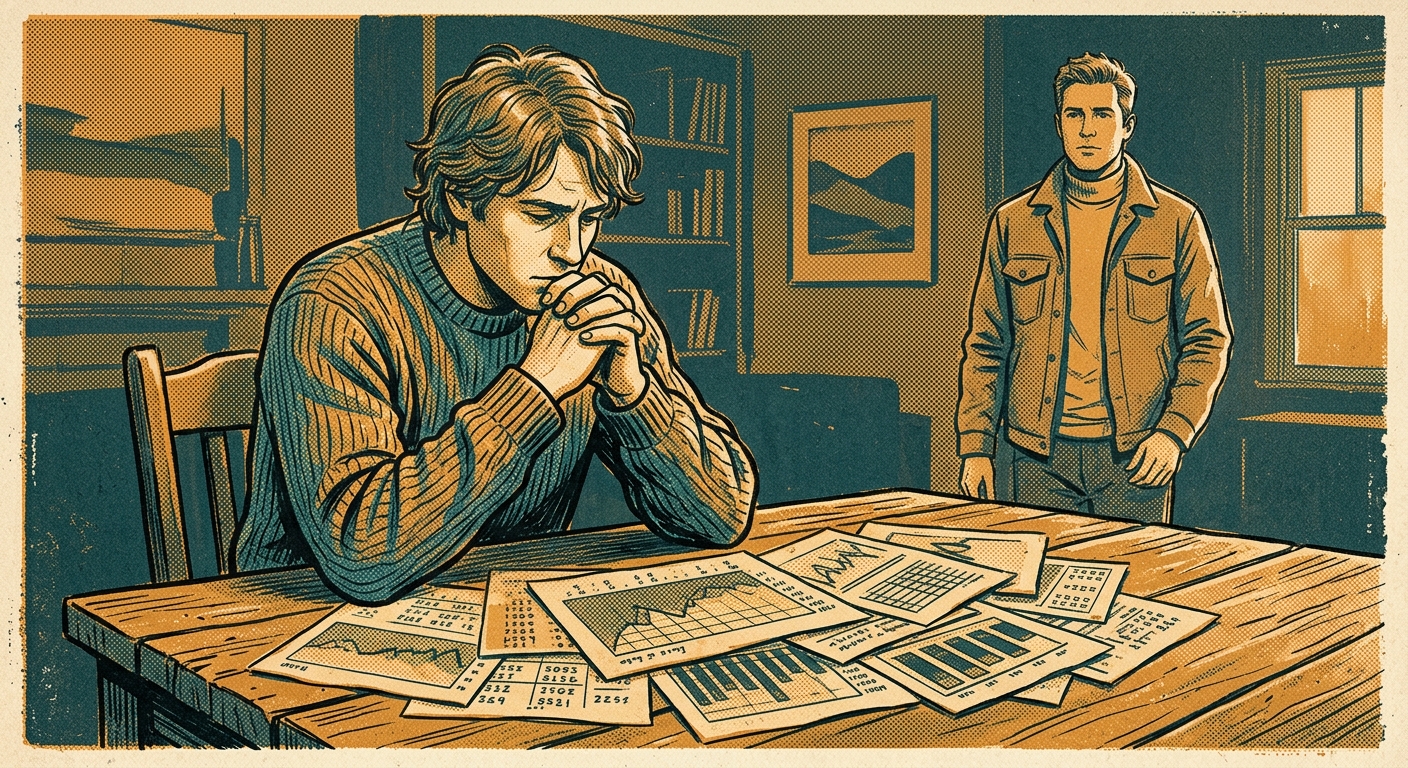
Imagine two people sitting across from each other at a workshop on personal growth. Both have a life path number 7. Both are introspective, analytical, a little private. But one of them keeps hitting a wall that the other doesn't seem to encounter — relationships that crumble right when they feel most certain, a tendency to build identity around being 'the smart one,' and a pattern of humiliation that comes, almost reliably, from pride. The other person with a 7 has hard days too, but that particular wall isn't theirs.
The difference? The first person has a 16 sitting in their chart — a karmic debt number that changes the texture of their 7 life path entirely.
This is what karmic debt numbers actually do. They don't curse you or assign you suffering from a previous incarnation. They point to a specific behavioral rut — usually one involving avoidance, excess, or misused strength — that keeps recurring until you actually address it. Understanding yours isn't about feeling burdened. It's about finally having a name for the pattern.
What a Karmic Debt Number Actually Is (Not What Most Sites Say)
Most numerology content handles karmic debt in one of two ways: either a brief mention that treats it as 'baggage from past lives,' or a dramatic warning that makes it sound like a spiritual penalty. Neither framing is especially useful.
Here's the thing — a karmic debt number is simply a double-digit number that appears during a standard numerology calculation and doesn't reduce without leaving a specific kind of residue. When you calculate a life path number, an expression number, or a birth day number, you're reducing multi-digit sums down to a single digit (or a master number). But certain double-digit numbers — specifically 13, 14, 16, and 19 — carry a distinct signal before they reduce to their root (4, 5, 7, and 1 respectively).
The logic goes like this: 10/1 reduces cleanly. 28/1 reduces cleanly. But 19/1 signals something specific about how that 1 energy is being expressed — namely, through a pattern of over-independence and resistance to receiving help. Same destination number, but a very different path to get there.
So karmic debt isn't a separate category you either have or don't have. It's a modifier that changes the quality of a root number in your chart. Think of it the way you'd think about a note with an accidental in music — same key, but different tone.
And it's worth noting: you don't automatically have a karmic debt number just because you have a 4, 5, 7, or 1 in your chart. Only the specific double-digit forms (13, 14, 16, 19) carry the designation. A life path that reduces through 22 → 4 is a master number situation, not karmic debt. A birthday on the 4th, the 13th, the 22nd, and the 31st all produce a 4 — but only the 13th carries karmic debt. The distinction matters.
If you want to check whether your own numbers carry any of these, the first step is to calculate your life path number correctly and trace the full reduction, not just the final digit.
The Four Karmic Debt Numbers and What Each One Signals
13/4: The Pattern of Avoiding Hard Work — and Paying for It
The 13 karmic debt is associated with taking shortcuts in situations that genuinely require sustained effort. Not laziness exactly — people with 13/4 are often quite ambitious — but a tendency to look for the faster route, to skip the foundational steps, and then to find that the structure collapses because the base wasn't solid.
The 4 energy in numerology is about building: systems, discipline, reliability. When 13 is the path to that 4, the person is being asked to learn what it actually means to do the boring, incremental work. The challenge isn't that they're bad at it. It's that they keep trying to avoid it, and the universe (or life, or circumstance — pick your framework) keeps putting them in situations where there's no workaround.
In practice, this looks like: jobs where someone rises quickly and then plateaus or falls because they don't have the technical foundation others built slowly; relationships where emotional shortcuts (assuming intimacy rather than building it) lead to rupture; creative work where the brilliant idea never becomes a finished product because the execution phase feels tedious.
The resolution isn't punishment. It's learning to respect process.
14/5: The Pattern of Excess and the Need for Self-Discipline
The 14 karmic debt sits in the domain of freedom, pleasure, and sensory experience — all of which are natural territories for the 5. But the 14 version of this comes loaded with a history (in numerological terms) of overindulgence and a misuse of freedom in ways that hurt others or destabilized things that needed stability.
People carrying 14/5 often have an intense relationship with appetite — whether that's substances, stimulation, relationships, or novelty. The pattern isn't about being hedonistic. It's about using freedom as escape rather than as genuine expression. And the recurring lesson is that real freedom requires self-governance. You can't have meaningful freedom if you're controlled by your own impulses.
This one often shows up as a person who is genuinely magnetic, adventurous, and interesting — but who has a trail of chaos behind them. The resolution involves developing discipline not as restriction, but as the container that makes real freedom possible.
16/7: The Pattern of Ego Collapse and the Rebuilding That Follows
This is probably the most dramatic of the four karmic debt numbers, and the one I find most people misread.
The 16/7 debt is connected to a pattern of building identity, status, or relationships on a false foundation — and then experiencing a collapse that strips it away. The 7 is already an introspective, spiritually-oriented number. But when the path runs through 16, the journey to that inner knowing tends to pass through a specific kind of humiliation or loss.
And here's the important part: the collapse isn't the punishment. It's the mechanism. The ego structure that gets built — often around being special, uniquely insightful, or elevated above ordinary people — eventually becomes unsustainable. The collapse clears the ground for something more authentic.
People with 16/7 in prominent chart positions often describe a pattern of 'before and after' moments in their lives — periods where everything they'd constructed seemed to fall apart, followed by a quieter but more genuine way of being. The shadow version is someone who keeps rebuilding the same ego structure after each collapse, never quite learning what it was built on.
For a deeper look at how this shadow dynamic plays out across all life path numbers, the shadow side of every life path number covers territory that pairs well with understanding karmic debt.
19/1: The Pattern of Misused Independence and Forced Self-Reliance
The 19 karmic debt is perhaps the most isolating of the four. It's linked to a history of self-centered use of power — acting independently in ways that didn't account for the people affected. The result is a life pattern where the person repeatedly finds themselves alone, unsupported, having to handle things without help.
But here's the thing — the lesson isn't 'stop being independent.' The 1 energy is genuinely about leadership and self-determination. The lesson is learning to stand on your own without either dominating others or becoming so self-sufficient that you close off connection.
People with 19/1 often have a complicated relationship with asking for help. Either they refuse it entirely (pride, or fear of appearing weak), or they swing into dependency and then feel resentful when support isn't there. The middle path — healthy interdependence, where you're capable of handling yourself but not afraid to lean on others — is what the number is pointing toward.
Where Karmic Debt Numbers Appear in Your Chart (It's Not Just Your Life Path)
A lot of people assume karmic debt only matters if it shows up in the life path number. But karmic debt can appear in several chart positions, and each placement has a different texture.
Life Path Number: This is the most significant placement. Karmic debt here means the pattern runs through your core life direction — it's likely to show up in major decisions, long-term goals, and the overall arc of how you move through life.
Expression (Destiny) Number: Calculated from your full birth name, the expression number governs how you show up in the world and what you're here to do. Karmic debt here tends to affect how you express yourself professionally and creatively — particularly the gap between your potential and your follow-through.
Birth Day Number: If you were born on the 13th, 14th, 16th, or 19th of any month, you carry the corresponding karmic debt in your birth day number. This placement is narrower — it tends to influence natural tendencies and ingrained habits more than life direction.
Soul Urge or Personality Number: These are less commonly flagged in karmic debt discussions, but they can carry the designation if the calculation passes through one of the four numbers. These placements affect internal motivation (soul urge) or the outer impression you make on others (personality).
If you want to understand how all of these positions fit together, what a full numerology chart actually shows is worth reading before or alongside this piece.
In my experience, having a karmic debt number in two or more positions amplifies the pattern — not in a catastrophic way, but in the sense that the same behavioral rut will show up in more areas of life simultaneously.
How a Karmic Debt Number Changes the Reading of Your Life Path
Worked Example: Life Path 7 With a 16 Karmic Debt vs. Plain Life Path 7
Let's make this concrete.
Person A has a birthdate that reduces to 7 through a clean path — say, born on July 7, 1990. The life path calculation is straightforward: 7 + 7 + 1 + 9 + 9 + 0 = 33, then 3 + 3 = 6... (that's not right, let's use a cleaner example). Born October 15, 1985: 1 + 0 + 1 + 5 + 1 + 9 + 8 + 5 = 30, reduces to 3. Let me give you a real 7 path.
Person A: Born April 14, 1983. Month: 4. Day: 14 → 1+4 = 5. Year: 1+9+8+3 = 21 → 2+1 = 3. Life path: 4+5+3 = 12 → 1+2 = 3. That's a 3. Let me just describe the principle clearly instead.
A plain life path 7 — one that arrives at 7 without passing through 16 — tends to manifest as natural introspection, a desire for knowledge and solitude, spiritual curiosity, and a somewhat reserved interpersonal style. The shadow side (as with all numbers) involves withdrawal, emotional unavailability, and a tendency to intellectualize rather than feel. But this is a relatively stable pattern.
A 16/7 life path carries all of that, plus a recurring dynamic around ego and collapse. Where the plain 7 might quietly withdraw, the 16/7 often builds elaborate internal structures about their own uniqueness or insight — and then has those structures dismantled by life events. The loss of a relationship they thought was perfect. A career built on a particular identity that suddenly becomes irrelevant. A spiritual framework that collapses when tested.
So when you're reading someone with a 7 life path, the question 'is this a 16/7 or a plain 7?' matters enormously. The guidance you'd offer is different. The patterns to watch for are different. The growth edge is different.
This is also why it's important to understand master numbers like 11, 22, and 33 in contrast — master numbers elevate the base number's potential, while karmic debt numbers add friction and a specific recurring challenge. They're not opposites, but they're very different kinds of modifiers.
How to Check Your Own Chart for Karmic Debt
The process is simpler than most people expect. You're looking for whether any of your key calculations pass through 13, 14, 16, or 19 before reducing to the final digit.
Step 1: Calculate your life path number in full. Don't just look up your birthday and find the single digit. Reduce month, day, and year separately, then add those three results together. If at any point a sub-total is 13, 14, 16, or 19 before it reduces, note it. To make sure you're doing this correctly, calculate your life path number correctly with a full reduction rather than a quick shortcut.
Step 2: Check your birth day number. If you were born on the 13th, 14th, 16th, or 19th, that's a direct karmic debt birth day number. No further calculation needed.
Step 3: Calculate your expression number. Assign numbers to each letter of your full birth name (using the Pythagorean system, where A=1, B=2... I=9, J=1, etc.), reduce each name to a single digit, add them together, and reduce again. If any step passes through 13, 14, 16, or 19, note it.
Step 4: Look at the full numerology chart picture. The spiritual meaning of numbers 1–9 provides the foundational framework for understanding what your root numbers mean — which helps you understand what a karmic debt number is modifying.
One practical caution: not every calculation that produces a number in the teens is karmic debt. The numbers 10, 11, 12, 15, 17, 18 don't carry the designation. And master numbers (11, 22, 33) are handled separately. Only 13, 14, 16, and 19 qualify. Be precise about this — it's easy to over-assign karmic debt when you're new to the system.
If you find one of these numbers in your chart, the most useful thing you can do isn't to worry about what you did in a past life. It's to look honestly at the behavioral pattern the number describes and ask where you're currently living it out. That's where the work is — not in the metaphysics, but in the mirror.
Start with your full chart calculation, trace every reduction carefully, and see what's actually there before you decide whether karmic debt is part of your picture.