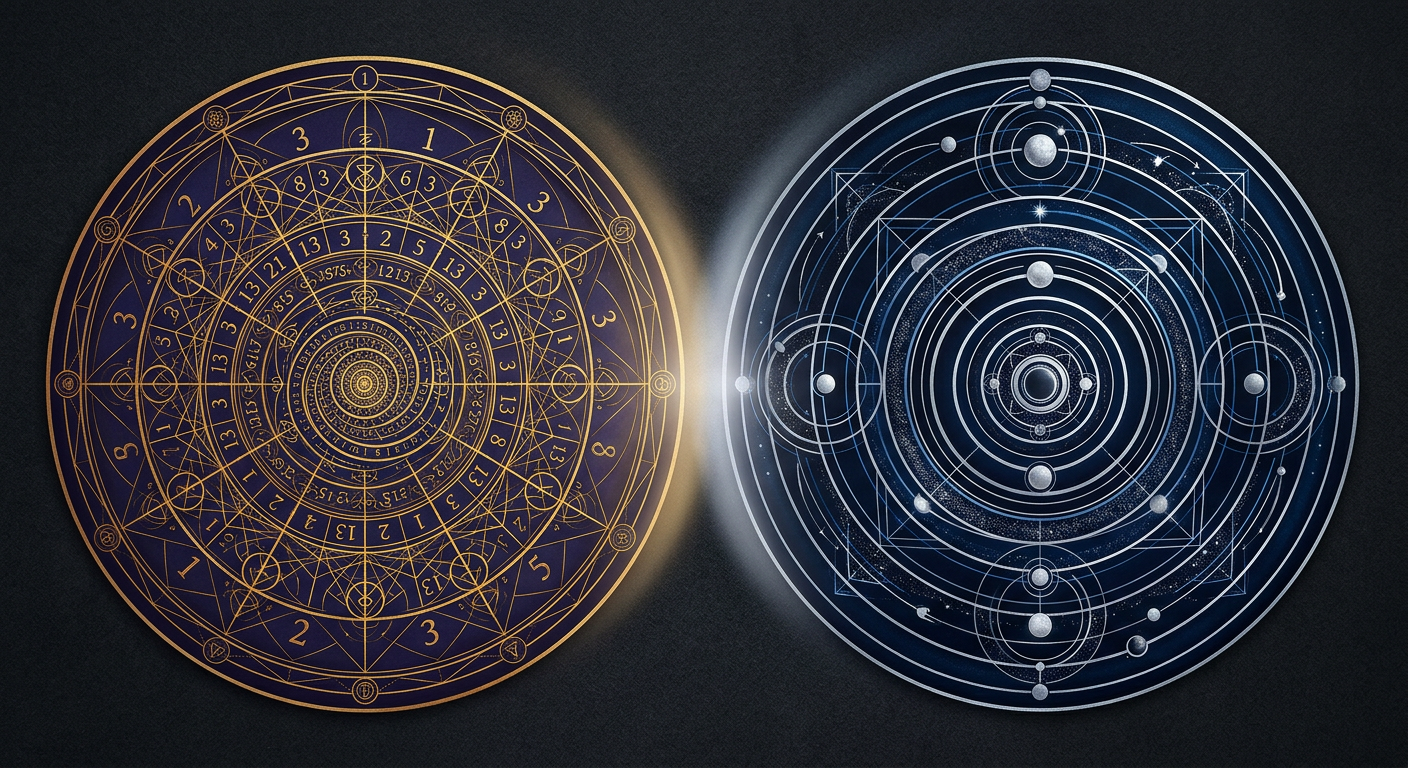
Two Tools, Two Completely Different Outputs from the Same Birth Data
Here's something most people don't realize until they've used both: a numerology calculator and an astrology birth chart generator can both start with your birthday — and produce outputs so different that they're practically answering separate questions about your life.
That's not a flaw. It's by design. These systems were built with different frameworks, different intentions, and different definitions of what 'knowing yourself' actually means. The confusion happens when people treat them as competing versions of the same tool, pick one, and then feel vaguely disappointed that it didn't do what the other one does better.
So instead of ranking them, let's actually look at what each tool produces — and more importantly, when you should reach for one over the other.
What a Numerology Calculator Actually Produces
A numerology calculator takes your birth data and converts it into numbers using a defined system — most commonly Pythagorean Numerology, which assigns numerical values (1–9, plus master numbers 11, 22, and 33) to letters and reduces multi-digit numbers to single digits through addition.
The output is a set of core numbers, each describing a different dimension of your personality, purpose, or inner life.
Life Path Number: The Core Output and What It Means
The Life Path Number is what most people are actually after when they use a numerology calculator. It's calculated from your full birth date — day, month, and year — and it's considered the most significant number in your numerology chart. Think of it as your overarching life theme: the energy you're here to work with, the patterns that keep showing up, the qualities you're meant to develop.
What makes it particularly useful is its simplicity and consistency. You can use our numerology calculator to get your Life Path Number instantly without knowing anything else about numerology — and you'll get the same result every time, on every reputable platform, because the math doesn't change.
Expression, Soul Urge, and Other Numbers Most Calculators Include
Beyond the Life Path, a full numerology reading typically includes:
- Expression Number (also called the Destiny Number): Derived from the numerical values of all letters in your full birth name. It describes your natural talents, abilities, and the way you engage with the world.
- Soul Urge Number (Heart's Desire): Calculated from the vowels in your birth name. It points to your deeper motivations — what you genuinely want beneath the surface.
- Personality Number: From the consonants in your name. Represents the outer face you show to others.
- Birthday Number: Simply your day of birth, unreduced. Adds nuance to the Life Path.
If you want to go deeper into what these layers reveal, the full numerology chart covers each component in detail and explains how they interact.
What a Numerology Calculator Cannot Tell You
Numerology doesn't do timing well — at least not with the same specificity as astrology. It can identify Personal Year cycles and Life Path periods, but it won't tell you that a particular three-week window in October is when a major career shift is likely. And it works with archetypes, not individual circumstances: two people with Life Path 4 will share core themes, but their lived experiences will look very different.
What an Astrology Birth Chart Actually Produces
An astrology birth chart (also called a natal chart) is a snapshot of the sky at the exact moment you were born. It maps the positions of the Sun, Moon, and all major planets across twelve houses and twelve zodiac signs — and the geometric relationships (aspects) between those planets.
The output is considerably more complex than a numerology profile. A full natal chart can run to dozens of meaningful data points, each requiring interpretation within a specific context.
The Minimum Data Required: Why Birth Time Matters
This is where things get complicated. To generate a complete and accurate birth chart, you need three pieces of information: your birth date, your birth location, and your exact birth time.
The birth time problem is real, and it matters more than most astrology apps acknowledge. Your Rising sign (Ascendant) — one of the three most important placements in your chart — changes roughly every two hours. Get the birth time wrong by two hours, and you have a different Rising sign entirely. The house system (which determines which life areas are governed by which signs and planets) is also entirely time-dependent.
This is exactly why your Life Path Number requires no birth time to be accurate — it's one of numerology's concrete advantages over astrology for everyday users who don't have their birth certificate handy.
Some astrologers use a process called 'birth time rectification' to estimate birth time based on life events — but this is a time-intensive, expert-level technique, not something a free app can reliably do.
Sun, Moon, Rising, and the Full Planetary Picture
For readers who have their birth time confirmed, a natal chart offers extraordinary depth:
- Sun sign: Your core identity and ego expression (the sign most people know from horoscopes).
- Moon sign: Your emotional nature, instincts, and what makes you feel secure.
- Rising sign (Ascendant): How you come across to others and how you approach new situations — often more recognizable in daily behavior than the Sun sign.
- Planetary placements: Mercury (communication), Venus (love and values), Mars (drive and action), and the outer planets each add layers of nuance.
- Houses: The twelve life domains — career, relationships, finances, health — each activated by different planetary energies.
What a Birth Chart Cannot Tell You
A birth chart is descriptive, not prescriptive. It can show tendencies and potentials — it doesn't dictate outcomes. And without a confirmed birth time, the Rising sign, house placements, and any time-sensitive calculations are either missing or unreliable. For a broader comparison of how astrology and numerology stack up on different criteria, the article on western vs. Vedic astrology vs. numerology lays out the trade-offs clearly.
Accuracy and Consistency: Which Tool Produces More Reliable Results?
The Birth Time Problem in Astrology
Studies on birth certificate accuracy suggest that recorded birth times can vary by 5–30 minutes from the actual moment of birth, due to rounding by hospital staff and differences in hospital clocks. For astrology, where the Ascendant can shift signs every two hours, even a 10-minute discrepancy can meaningfully affect chart interpretation.
And many people simply don't know their birth time at all. Hospital records weren't always kept with precision, home births were often undocumented, and international birth records vary enormously in what they capture.
Why Numerology Calculators Are More Consistent Across Platforms
With Pythagorean Numerology, the calculation method is standardized enough that reputable calculators produce identical results. Your Life Path Number from one platform will match another — assuming both follow standard reduction rules (and handle master numbers 11, 22, and 33 correctly without reducing them further).
This consistency is a genuine practical advantage. You can verify your numbers independently, and the output doesn't shift based on data you may not have.
Use Case Comparison: Which Tool to Reach for First
| Strategy | Best For | Pros | Cons | ROI / Value |
|---|---|---|---|---|
| Numerology Calculator | Personality understanding, core purpose, name analysis | No birth time needed, consistent output, immediate results | Less useful for timing, works with archetypes not individual events | High — reliable baseline in minutes |
| Astrology Birth Chart (with confirmed time) | Deep personality mapping, timing, forecasting, relationship synastry | Extraordinary depth and specificity, timing precision via transits | Requires exact birth time, steep learning curve, interpretation varies | Very high — but only with accurate data |
| Astrology Birth Chart (without birth time) | Sun sign basics, Moon sign, some planetary placements | Still useful for Sun/Moon/planetary signs | Missing Rising sign and house system — chart is incomplete | Moderate — significant gaps |
| Combined Numerology + Astrology | Full self-discovery, cross-validation, relationship work | Complementary layers, richer picture | Time investment to learn both, potential interpretation conflicts | High — strongest overall approach |
For Personality Understanding
If you want a quick, reliable personality profile with no prerequisites, reach for the numerology calculator first. Your Life Path Number, Expression Number, and Soul Urge Number together give you a coherent picture of your core nature, your natural gifts, and your inner motivations — without needing to verify any additional data.
Astrology goes deeper on personality, but only if you have a confirmed birth time. Without it, you're missing the Rising sign, which many astrologers consider the most important placement for understanding day-to-day personality.
For Timing and Forecasting
Astrology wins here, clearly. Planetary transits — the ongoing movement of planets relative to your natal chart — create time-specific energetic windows that numerology's Personal Year and Life Path period cycles can't match for specificity. If you're trying to understand why a particular year or season feels significant, astrology's forecasting tools are more granular.
That said, numerology's Personal Year cycles are underrated for annual planning. They're not as specific as astrology transits, but they're also not wrong.
For Relationship Compatibility
Both systems have compatibility frameworks. Numerology uses Life Path Number compatibility (and sometimes Expression Number comparisons). Astrology uses synastry — overlaying two natal charts to see how planets in one chart aspect planets in the other.
Astrology's synastry is more nuanced, but again — it requires both people's confirmed birth times. Numerology compatibility analysis is faster and requires only birth dates (and names for Expression Number comparison). For a grounded look at how both systems handle this, numerology and astrology combined offers a practical framework for using both without contradiction.
The Best Free Tools for Each System and What They Get Right
For numerology, the best free calculators share a few qualities: they show their calculation steps (so you can verify), they handle master numbers correctly (not reducing 11, 22, or 33 to 2, 4, or 6), and they explain what each number means in plain language rather than vague mystical language.
For astrology, the gold standard free tool is Astro.com — it generates complete natal charts with full house systems, aspect grids, and interpretation options. What it gets right is transparency: it clearly indicates when a birth time is unknown and adjusts the chart display accordingly (typically showing a noon chart or omitting house placements).
What to watch for with free tools in both categories: any platform that generates a 'numerology and astrology calculator' combined output in a single click is almost certainly oversimplifying one or both systems. Genuine integration requires human interpretation of how the systems interact — it's not something an algorithm handles well.
When to Use Both Together: A Practical Workflow
Here's the workflow I'd actually recommend, especially if you're new to both systems:
Step 1: Start with your Life Path Number. It's the fastest, most reliable baseline, and it requires nothing beyond your birthday. This gives you a foundation to work from immediately.
Step 2: Pull your Expression Number and Soul Urge Number using your full birth name. Now you have a three-number profile that covers purpose, talent, and motivation.
Step 3: If you have a confirmed birth time, generate your natal chart. Focus first on the Sun-Moon-Rising combination — this trio alone gives you enormous insight into personality. Compare how it complements (or complicates) your numerology profile.
Step 4: Use numerology for annual planning (Personal Year cycles) and astrology for more specific timing questions (major transits, solar returns).
Step 5: When the two systems seem to contradict each other, don't force a resolution. Note the tension. Often it reflects a genuine complexity in your nature rather than an error in either system.
Look, neither tool is a crystal ball. But used with clear expectations, both offer something genuinely useful — and the key is knowing which question to ask each one. Reach for the numerology calculator when you want clarity fast and don't want data reliability to be a question. Reach for the astrology chart when you have your birth time confirmed and want depth, specificity, and timing information.
And if you haven't started yet — use our numerology calculator to get your Life Path Number instantly and see what your birth date actually says about you. It's the most reliable first step either system can offer.