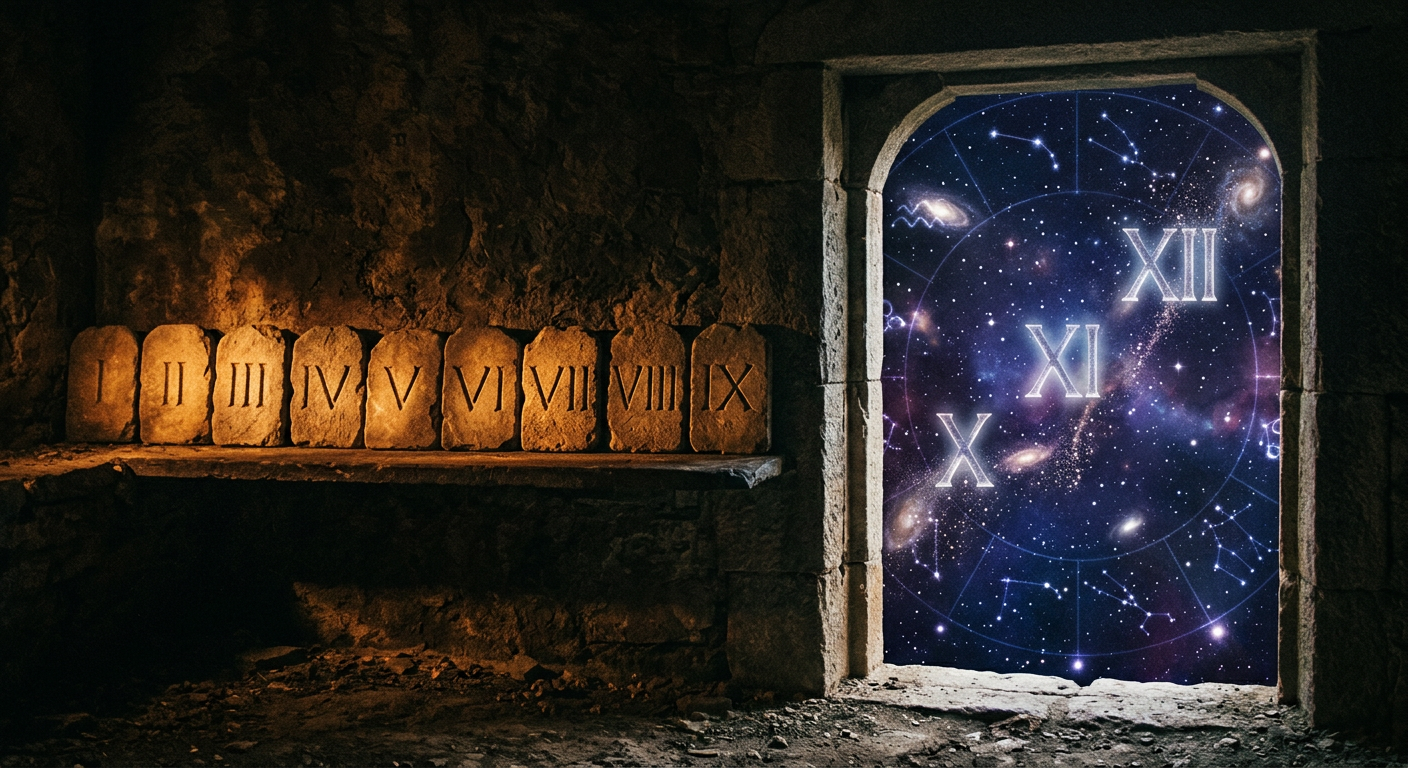
Most people encounter numerology as a list. Twelve meanings, twelve numbers, twelve separate boxes to check. And that approach produces a strange kind of confusion — you understand each number in isolation, but you have no idea how they talk to each other.
Here's the thing: the numbers 10, 11, and 12 aren't a separate chapter added onto the core system. They're the system's natural extension, and they only make sense when you understand what came before them. Treating them as standalone symbols is like reading the last three chapters of a book without the first nine.
This article maps 10–12 back to the 1–9 foundation — explicitly and structurally — so you can see how the full range holds together as a coherent framework rather than a collection of isolated meanings.
Why the 1–9 Framework Is the Foundation, Not the Full Picture
The numbers 1 through 9 represent, in most spiritual and numerological traditions, a complete cycle of human experience. Start with 1 (individuality, initiation) and work through to 9 (completion, wisdom, release) — and you've traced an arc that covers the full range of personal development. That's not an accident. It's a structural design.
In the spiritual meaning of numbers 1–9, the core framework describes how each single-digit number carries a distinct energetic signature. One is the self. Two is relationship. Three is expression. And so on through nine. These aren't arbitrary assignments — they follow an internal logic based on how each number relates to the others mathematically and symbolically.
But here's where most explanations stop short: they present 1–9 as the complete system and then treat 10, 11, and 12 as bonus content. That framing is structurally wrong. The 1–9 sequence is the foundation. Numbers 10–12 extend it upward — they add a layer of cyclical, cosmic, and transpersonal meaning that the single digits can't fully carry on their own.
Think of it this way. If 1–9 maps the arc of individual human experience, then 10–12 begins to describe what happens at the threshold — the moment when a completed cycle meets the beginning of the next one. That's a different kind of meaning, and it requires a different kind of number.
So before exploring what 10, 11, and 12 add, it's worth being clear about what the 1–9 framework actually provides: a complete map of individual experience that the extended numbers will build on top of, not replace.
Numbers 10, 11, and 12: How They Extend the Core Sequence
Number 10: Completion and the Return to Unity
Ten is the number that stands at the exact boundary between cycles. It contains a 1 and a 0 — and that composition is the entire story. The 1 signals a new beginning; the 0 signals the void, the infinite potential that exists before form takes shape. Together, they describe a moment of transition: something has finished, and something new is about to begin at a higher level of awareness.
In Pythagorean numerology, 10 typically reduces to 1 (1+0=1). That reduction is meaningful — it tells you that the core energy of 10 is the same initiating, self-directed force as 1, but it arrives after a full cycle has been completed. It's not the naive beginning of 1. It's the experienced beginning.
Across spiritual traditions, 10 carries the weight of completion. The Ten Commandments, the ten Sephiroth in Kabbalistic tradition, the ten avatars of Vishnu — each of these represents a complete and ordered system. (And it's worth noting that these aren't just cultural coincidences — the number 10 consistently appears in frameworks meant to express wholeness rather than parts.)
For practical purposes, when 10 appears in a numerological reading or as a recurring number pattern, interpret it as: a cycle has closed, and the energy of 1 is available again — but informed by everything that came before.
Number 11: The First Master Number and the Gateway to Higher Awareness
Eleven is the first point in the sequence where Pythagorean numerology refuses to reduce. Most double-digit numbers collapse into a single digit — but not 11, not 22, not 33. These are called master numbers, and they're treated as carrying a charge that's too significant to simplify away.
Master number 11 sits at the threshold between the personal (the 1–9 range) and the transpersonal. It's composed of two 1s — two individual forces placed side by side — which creates an unusual dynamic: the self in direct conversation with a higher version of itself. This is why 11 is so often associated with intuition, spiritual awakening, and what some traditions call 'illumination.' It's not that 11 is mystically superior to other numbers. It's that 11 describes a specific kind of awareness — the moment when personal experience begins to open toward something larger.
If you want to go deeper on how master numbers function as a distinct category, master numbers 11, 22, and 33 deserve their own focused treatment. But for this framework, the key point is structural: 11 extends the 1–9 sequence by introducing the concept of doubled intensity — a number that amplifies its root energy (1) rather than transitioning to the next number in the cycle.
And in daily life, when 11 appears as an angel number — especially in patterns like 11:11 — the most coherent interpretation isn't supernatural. It's a signal to pay attention to the quality of your awareness in that moment. What are you initiating? What is the self you're bringing to this new beginning?
Number 12: Cosmic Order, the Zodiac, and Cyclical Completion
If 10 is the completion of a personal cycle and 11 is the gateway to higher awareness, then 12 is the number that encodes cosmic order. And it does this with unusual consistency across traditions.
Twelve divides evenly into 1, 2, 3, 4, and 6 — making it one of the most mathematically versatile numbers in the sequence. That divisibility is part of why it keeps appearing as an organizing principle in systems that need to divide reality into manageable, balanced parts. The zodiac has 12 signs. The year has 12 months. Time is measured in 12-hour cycles. These aren't spiritually loaded choices in every case — but they reflect the same mathematical property that also makes 12 spiritually useful.
In numerology, 12 reduces to 3 (1+2=3) — the number of expression, creativity, and synthesis. That reduction is telling. After the completion of 10 and the heightened awareness of 11, the system arrives at 12, which synthesizes the experience into something expressible. It's a completion that generates new form.
Where 10–12 Appear Across Spiritual Traditions
The 12 Disciples, 12 Tribes, and 12 Zodiac Signs: Pattern or Coincidence?
Look across the major spiritual and cultural traditions and you'll find 12 doing the same structural work in very different contexts. The 12 apostles in Christian tradition. The 12 tribes of Israel in Hebrew scripture. The 12 zodiac signs in Western and Vedic astrology. The 12 Olympians in Greek mythology. The 12 months of the solar year in virtually every calendar system.
The question worth asking isn't whether these are all the same symbol — they're clearly not. The question is what they share structurally. And the answer is this: 12 consistently appears when a tradition needs to represent a complete, ordered system of differentiated parts. It's not that 12 is mystically sacred across all cultures. It's that 12's mathematical properties make it unusually good at encoding completeness-with-diversity — the idea that a whole can contain distinct, non-overlapping parts that together cover the full range.
For anyone interested in how numerological frameworks intersect with astrological ones, numerology and astrology combined explores exactly that territory — and the number 12's role in the zodiac is a natural bridge between the two systems.
The 12 tribes of Israel and the 12 apostles follow the same structural logic: twelve distinct units that together represent a complete, divinely ordered whole. Whether you read these as historical, symbolic, or both, the number 12 is doing the same work in each context.
11 as a Master Number in Numerology vs. Its Role in Other Systems
In Pythagorean numerology — the dominant Western system — 11 is explicitly categorized as a master number. That designation means it carries heightened spiritual potential and isn't reduced in most calculations. But in other traditions, 11's significance is expressed differently.
In the Tarot, for example, 11 is associated with Justice (in some decks) or Strength (in others). In certain angel number frameworks, 11:11 is treated as a portal or activation sequence — a moment when the boundary between ordinary and heightened perception thins. These aren't the same claim as Pythagorean numerology's master number designation, but they're pointing at the same underlying quality: 11 as a threshold, a doubled-1, a signal of intensity at a boundary.
What matters for your practice is knowing which framework you're working in. If you're doing a numerological reading, treat 11 as a master number and don't reduce it. If you're interpreting a recurring 11:11 pattern in daily life, you're working more in the angel number territory — and there, the what numbers represent spiritually across traditions lens is more useful than strict Pythagorean rules.
How to Apply the 1–12 Framework Without Overcomplicating Your Practice
When to Use the Extended Range vs. Reducing Back to 1–9
This is the practical question that most explanations avoid. When should you work with 10, 11, and 12 as distinct numbers, and when should you reduce them back to their single-digit roots?
Here's a framework that actually works:
| Situation | Use Extended (10–12) | Reduce to 1–9 |
|---|---|---|
| Interpreting angel numbers or recurring patterns | Yes — the full number carries the signal | Rarely |
| Calculating life path, expression, or soul urge numbers | Only for 11 and 22 (master numbers) | Yes — reduce everything else |
| Reading 12-based systems (zodiac, months, disciples) | Yes — context is cosmic/cyclical | Not applicable |
| Personal year or cycle calculations | Reduce first, note master numbers | Yes |
| Exploring symbolic meaning in scripture or mythology | Yes — historical use matters | Not necessary |
The rule of thumb: keep the extended number when the context of the number is the point. Reduce to the single digit when you need the core energy without the contextual layer. Both are valid — they're just answering different questions.
And if you want to calculate your life path number directly, keep in mind that the master number rule applies: if your calculation produces 11, 22, or 33 at any intermediate step, you typically preserve it rather than reducing further.
The Relationship Between 1–12 and Recurring Number Patterns in Daily Life
Recurring numbers in daily experience — on clocks, receipts, license plates, timestamps — are what most people call angel numbers. And the 10–12 range appears constantly in this context. 10:10, 11:11, 12:12 on a clock face are probably the most frequently noticed.
The problem with most angel number interpretations is that they treat each number in isolation, with a fixed and often vague meaning ('abundance is coming,' 'trust the universe'). That approach isn't wrong exactly — but it's shallow.
A structurally coherent approach looks like this:
- Identify the root energy. 10 → 1 (initiation). 11 → 11/2 (intuition, duality). 12 → 3 (expression, synthesis).
- Apply the contextual layer. 10 adds: this initiation follows a completed cycle. 11 adds: this awareness is heightened, operating at a transpersonal frequency. 12 adds: this expression is cosmically ordered, part of a larger pattern.
- Connect to what's actually happening in your life. The number is a prompt, not a prediction. What cycle is completing? What is the self you're bringing to this new beginning? What larger pattern are you expressing?
This approach works because it respects the structural logic of the sequence. Each number in the 1–12 range carries a meaning that builds on what came before — and that building is the whole point.
For readers interested in how this intersects with other interpretive systems, biblical meaning of numbers in scripture vs. numerology offers a useful contrast — particularly for numbers like 12, which carries heavy weight in both biblical and numerological contexts, but for different structural reasons.
Overcoming the Tendency to Treat 10–12 as Separate
The biggest obstacle to using the 1–12 framework effectively is a habit of mind: treating each number as a self-contained unit with a fixed meaning rather than as a position in a sequence.
This habit comes from how numerology is usually taught — as a list of correspondences rather than as a structural system. You learn that 7 means 'introspection' and 11 means 'intuition' and 12 means 'completion,' and you have twelve separate tools. But you don't have a framework. You have a vocabulary without grammar.
The reframe that actually helps: think of 1–12 as a sentence, not a dictionary. Each number has meaning in relation to the others. Ten means something specific because it comes after nine and before eleven. Eleven is significant not just because it's 'master energy' but because it's the first refusal to reduce — it's the sequence's first deliberate pause at a threshold. Twelve closes a cosmic cycle and opens the possibility of the next.
So the practical advice is this: before assigning meaning to any number in the 10–12 range, ask yourself — what came before it in the sequence? What does the core energy of its reduced form tell me? And how does the extended form amplify or contextualize that core?
That question sequence won't give you a mystical revelation. But it will give you a structurally coherent interpretation that actually holds up under scrutiny — which is more useful for sustained practice than any list of meanings.
1–12 as a Layered System Built on the 1–9 Core
The numbers 1–12 work as a framework precisely because they're not arbitrary. Each number in the sequence earns its meaning through its relationship to the others, and 10, 11, and 12 extend that logic rather than departing from it.
Ten completes the first major cycle and reintroduces the energy of 1 with accumulated wisdom. Eleven introduces the concept of the master number — a doubled intensity that refuses reduction and operates at a transpersonal frequency. Twelve encodes cosmic order and cyclical completion, appearing across traditions because its mathematical structure makes it uniquely suited to represent wholeness-with-diversity.
None of this requires treating numerology as literal truth. I think the most honest way to use any number framework is as a structural lens — a way of organizing experience that draws attention to patterns you might otherwise miss. And the 1–12 extended framework, understood as a layered system built on the 1–9 core, is one of the more coherent lenses available.
Your practical next step: take any number between 10 and 12 that's been recurring in your experience, reduce it to its single-digit root, and spend a few minutes with the question that root number is asking. Then layer the extended number back on top — what does the contextual layer add? That two-step process is the whole framework in miniature. Start there.