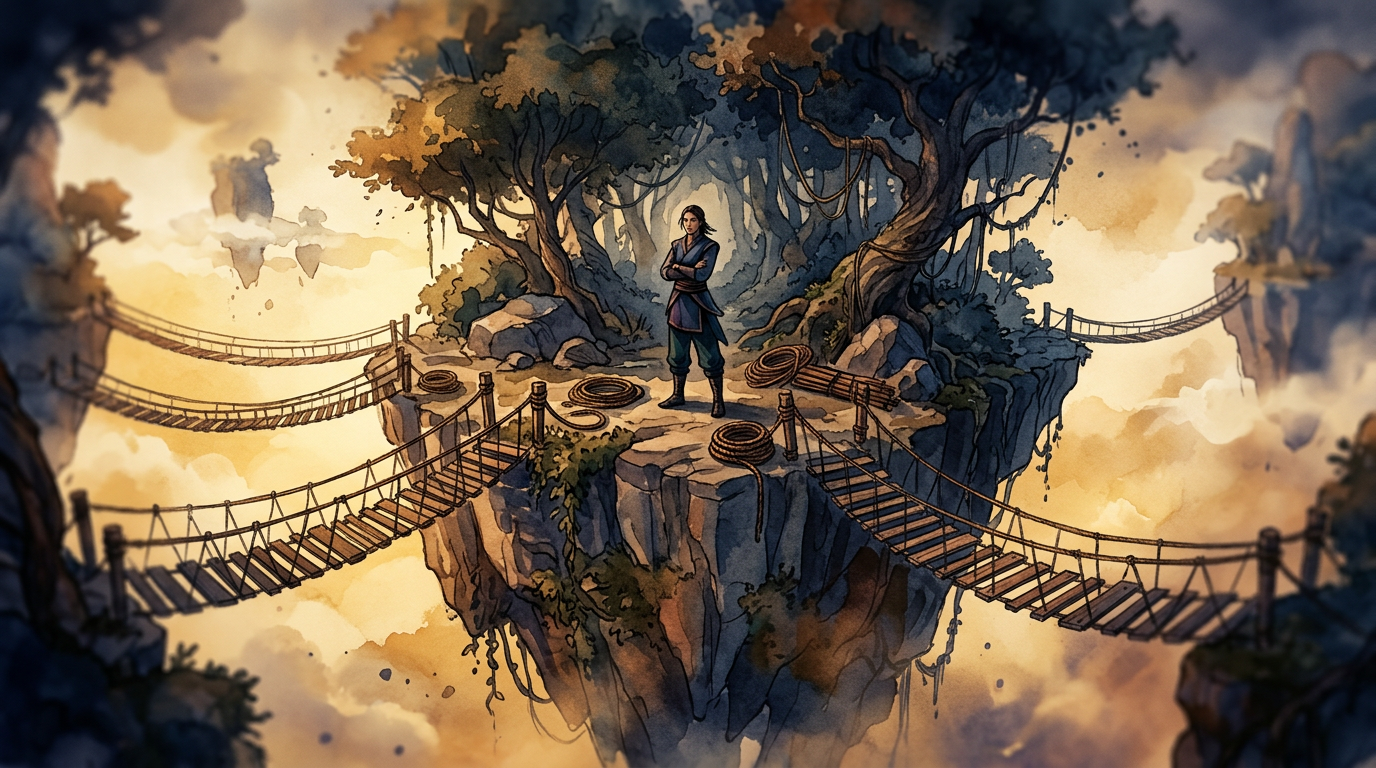
Imagine someone who has built everything alone. The career, the reputation, the carefully constructed life. And now, sitting across from a friend who's offering genuine help during a genuine crisis, they feel something unexpected: irritation. Not gratitude. Not relief. Irritation.
That irritation is karmic debt 19 in action.
It's one of the four karmic debt numbers in numerology — 13, 14, 16, and 19 — and it's arguably the most psychologically complex of the group. Not because the lesson is harder in theory, but because the wound and the medicine are almost indistinguishable to the person carrying it. To understand how karmic debt number 19 fits into the broader karmic debt framework, you first have to understand why this particular number creates such a specific, stubborn trap.
The trap is this: karmic debt 19 is built on misused independence. The cure is interdependence. But to someone whose entire identity is organized around self-sufficiency, interdependence doesn't feel like healing. It feels like collapse.
Common Misconceptions About Karmic Debt 19
Myth 1: Karmic debt 19 means you'll be punished for being too independent.
This is probably the most common misread. Karmic debt 19 isn't a punishment for having a strong will or wanting autonomy. Independence itself isn't the problem. The numerological tradition here is more specific: the issue is independence exercised at others' expense. Leadership without accountability. Using personal power to avoid responsibility to the collective. There's no cosmic grudge against self-reliant people.
Myth 2: If you have karmic debt 19, you're selfish.
Look, I've worked with people who carry this number and who are genuinely among the most giving people I know. The past-life pattern this debt references isn't necessarily conscious selfishness — it's more structural than that. It's the refusal to be accountable to anyone. That can coexist with generosity. What it can't coexist with is genuine vulnerability.
Myth 3: Resolving karmic debt 19 means becoming a team player in some corporate-seminar sense.
This advice, when I've seen it given, tends to miss the point entirely. The resolution isn't about joining committees or delegating tasks. It's an internal shift — from treating self-sufficiency as armor to treating connection as a strength. That distinction matters more than any behavioral checklist.
Core Principles: Understanding the 19 Pattern
Past-Life Origins: Power Used Without Accountability
In the numerological framework, karmic debts represent patterns from previous lifetimes that didn't reach resolution. With karmic debt 19, the pattern is specifically about power — having it, using it, and failing to remain accountable to those affected by it.
The number 19 reduces to 1 (1+9=10, 1+0=1). But it arrives at 1 differently than a simple Life Path 1 does. It carries the full weight of the 9 — completion, wisdom, humanitarian awareness — alongside the pioneering force of the 1. In the karmic debt reading, this suggests a soul that had access to significant personal power and the broader awareness to use it wisely, but chose not to. Leadership without service. Influence without accountability.
Why This Debt Keeps Showing Up as Isolation
Here's the thing about patterns that originated in power misuse: they tend to flip in the next cycle. A soul that avoided interdependence when it was powerful may find itself, in this lifetime, in repeated situations that force dependence. Job losses that require asking for help. Health challenges that require caregiving. Relationships that demand vulnerability. The universe (or whatever mechanism you prefer to attribute this to) seems to keep presenting the exact scenarios that the 19 carrier finds most uncomfortable.
And when those scenarios arrive, the response is often to double down. To isolate. To rebuild the walls higher rather than accept the offered help. This creates a loop — and the loop is the debt.
How Karmic Debt 19 Expresses Itself Today
Extreme Self-Reliance as a Defense Mechanism
People with karmic debt 19 often build their identity around not needing anyone. And they're usually quite good at it — 1-energy is genuinely capable, driven, and resourceful. So for a long time, the defense works. They don't need help, because they're skilled enough to avoid needing it.
But this is armor, not strength. The difference becomes visible under sustained pressure. Real strength can flex — it can ask, receive, collaborate without feeling diminished. Armor can't. When the pressure gets high enough, armor either holds (at enormous personal cost) or shatters. Karmic debt 19 carriers often experience one of these two outcomes repeatedly before recognizing the pattern.
Difficulty Asking for or Accepting Help
This isn't stubbornness in the ordinary sense. It's more visceral than that. Asking for help, for someone running a 19 pattern, can feel physically wrong — like a violation of something fundamental about who they are. I've seen this described by people as feeling 'weak,' 'exposed,' or even 'disgusting.' That's not a rational assessment. That's a deep-wired pattern responding to a perceived threat.
And the threat it's responding to is loss of self. Somewhere in the architecture of karmic debt 19 is a belief that accepting help means giving up control, and giving up control means ceasing to exist as an autonomous person. So they don't ask. And the isolation compounds.
Repeated Situations That Force Dependence
This is the most visible external marker of karmic debt 19 in action. These individuals tend to attract — or find themselves in — circumstances that strip away their self-sufficiency. Financial collapses after years of independence. Illnesses that require care. Professional failures that demand they rebuild with others' support.
From the outside, it can look like bad luck. From the inside, it feels like attack. But from the numerological perspective, it's the debt presenting its lesson: you cannot do this alone, and trying to will cost more than accepting help would.
The 1-Energy Foundation: Leadership Relearned
What Healthy 1-Energy Looks Like for Karmic Debt 19
Not all 1-energy is karmic debt 19. Most Life Path 1 individuals have a clean relationship with leadership — they lead naturally, they're comfortable with authority, and they don't necessarily struggle with isolation in the way 19 carriers do. You can read more about the shadow side of this energy in the context of the darker expressions of each Life Path number.
For someone carrying karmic debt 19, the goal isn't to suppress the 1-energy. It's to mature it. Healthy 1-energy for a 19 carrier looks like: leading in ways that explicitly include others, using personal capability to build collective capacity rather than replace it, and being willing to be seen in moments of need without treating that visibility as failure.
The Difference Between Independence and Isolation
This is the distinction I think matters most, and it's one I rarely see made clearly in numerology writing.
Independence is a chosen state. You can choose to work alone because you work better that way, and you can un-choose it when collaboration serves you better. Independence is fluid. It's a preference, not a prison.
Isolation is what independence becomes when it's driven by fear. The 19 carrier who is isolated isn't choosing solitude — they're trapped in it. They can't un-choose it without triggering the threat response. That's the distinction. And recognizing which one you're in is genuinely difficult when you've been in it long enough that it just feels like 'who you are.'
Karmic Debt 19 Across Chart Positions
Life Path 19/1
When karmic debt 19 sits on the Life Path, it's the dominant theme of the entire incarnation. If you calculate your life path number and arrive at 19 before reducing to 1, every major life theme will carry the 19 fingerprint: the drive for autonomy, the recurring situations that demand help, the internal war between pride and need.
Life Path 19/1 individuals are often visibly accomplished — the 1-energy is real and it produces results. But their relationship history, their health patterns, and their moments of greatest crisis tend to cluster around the same wound: the refusal to let anyone in. Partners describe feeling shut out. Friends describe feeling unnecessary. And the 19/1 themselves often describe a persistent, low-grade loneliness they can't quite explain, given how capable they are.
Birthday Number 19
The Birthday Number represents a more specific talent or challenge rather than the Life Path's overarching theme. When 19 appears as the Birthday Number, the karmic debt pattern tends to show up in particular domains — often in professional settings or in the way the person handles crisis — rather than permeating every area of life.
Someone with a Birthday Number of 19 might have genuinely warm, reciprocal relationships but find themselves completely unable to accept help at work. Or they might navigate friendship beautifully but collapse into isolation when facing health challenges. The debt is more contained, but it's no less real in the areas where it operates.
If you're not sure where karmic debt 19 sits in your chart, it's worth looking at whether you actually have a karmic debt number and where it falls.
Practical Tactics for Resolving Karmic Debt 19
Here's where most numerology articles get vague. 'Embrace your vulnerability' is not actionable advice for someone whose nervous system treats vulnerability as a threat. So let me be specific.
| Technique | Best Use | Outcome |
|---|---|---|
| Structured small asks | Daily practice — ask for one small, low-stakes thing per day (directions, a recommendation, a favor) | Gradually de-escalates the threat response around asking for help |
| Reframe help as leadership strategy | Use in professional contexts where the 19 carrier is most defended | Converts 'accepting help' from weakness to strategic intelligence |
| Name the loop out loud | Use when you notice yourself about to isolate | Interrupts the automatic response by making it conscious |
| Identify the 'I'll handle it' moment | Use in relationships — notice when you default to solo problem-solving | Creates a pause point before the isolation pattern kicks in |
| Practice receiving without deflecting | Use with compliments, offers, and support — resist the urge to immediately reciprocate or minimize | Builds tolerance for being on the receiving end of care |
| Journal the cost of isolation | Use during periods of clarity, not crisis | Builds long-term awareness of what the pattern actually costs |
| Choose one 'accountability person' | Ongoing — one trusted person who knows about the pattern | Creates a structural support that doesn't require asking in the moment |
None of these are spiritual exercises. They're behavioral interventions. And I think that framing matters for 19 carriers specifically, because spiritual framing often triggers the same resistance as emotional framing. Give the analytical brain something to work with.
Measuring Progress: What Resolving Karmic Debt 19 Actually Looks Like
Progress with karmic debt 19 isn't linear, and it doesn't look like a personality transplant. Here's what genuine movement tends to look like:
Early stage: You notice the resistance to asking for help after you've already refused it. This is actually progress — it means the pattern is becoming visible.
Middle stage: You notice the resistance in the moment and occasionally override it. You ask for help, feel uncomfortable, and survive the discomfort. This is the core work.
Later stage: Asking for help stops triggering a threat response. You can choose interdependence without it feeling like self-betrayal. Independence becomes something you choose, not something you're trapped in.
Benchmarks worth tracking: how often do you ask for help in a given week? How does your body respond when someone offers support — tension or ease? How long does it take you to reach out when you're struggling, versus how long you white-knuckle it alone?
Compare this with the patterns addressed in karmic debt number 14 — that debt is also about freedom, but its mechanism is very different. Where 14 struggles with excess and moderation, 19 struggles with the terms of its own autonomy. Understanding these distinctions helps clarify which pattern is actually running.
Future Trends: How Karmic Debt 19 Shows Up in Modern Life
The cultural context for karmic debt 19 has shifted significantly. We're in an era that celebrates hustle, independence, and the self-made narrative more than perhaps any previous generation. Social media rewards the lone achiever. 'I built this myself' is a status symbol.
For karmic debt 19 carriers, this environment is both comfortable and dangerous. Comfortable because the cultural narrative validates their pattern. Dangerous because it gives the debt an ideological shield — 'I'm not isolating, I'm self-sufficient, and self-sufficiency is a virtue.'
The emerging counter-narrative around mental health, interdependence, and community might actually be the most useful external force for 19 carriers in 2026. As cultural permission to need people becomes more available, the internal permission might follow. That's not guaranteed — deep patterns don't shift because the culture shifts — but the environment is becoming slightly less hostile to the lesson karmic debt 19 is trying to teach.
For anyone wanting to understand how this debt sits alongside other numbers in a complete picture, a full numerology chart will show how the 19 interacts with other energies — sometimes amplifying the isolation pattern, sometimes providing counterweights.
Also worth noting: if you're comparing karmic debts to karmic lessons, which are a different mechanism entirely, that distinction is explained clearly in the comparison between karmic debt numbers and karmic lessons.
Where Does 19 Fit Among the Four Karmic Debts?
The four karmic debt numbers are 13, 14, 16, and 19. Each targets a different dimension of unresolved soul-level pattern:
- 13 is about the avoidance of disciplined effort — the debt of shortcuts taken at others' expense.
- 14 is about the misuse of freedom — excess, instability, and the refusal to commit.
- 16 is about ego and the destruction that follows inflated self-importance.
- 19 is about the misuse of personal power and independence — the refusal to be accountable to anyone.
Of the four, 19 is the one that most frequently hides behind apparent strength. The 13 carrier often knows they're struggling with discipline. The 14 carrier can usually see their instability. The 16 carrier tends to experience dramatic external collapses that make the pattern undeniable. But the 19 carrier can look, for decades, like someone who has it completely together — right up until the moment they don't, and by then the isolation is so complete there's almost no one left to help.
That's what makes it the loneliest of the four debts. And that's what makes awareness of the pattern so critical — not as a spiritual achievement, but as a practical survival skill.
If you recognized yourself in any part of this, the most useful next step isn't abstract. Start with your chart. Calculate your life path number and identify where 19 appears — Life Path, Birthday Number, or elsewhere. Then pick one item from the tactics table above and try it for two weeks. Not as a transformation project. Just as an experiment. The pattern doesn't break all at once. It loosens, slowly, through repeated small choices to reach out instead of pulling in.