Why People Conflate Numerology and Angel Numbers — and Why It Matters
Somewhere around 78% of Americans report believing in at least one form of spiritual or metaphysical phenomenon, and number-based systems are among the most widely explored. Yet most people who are actively working with numbers — whether they're calculating their Life Path or photographing every 11:11 they see on a clock — can't clearly articulate the difference between numerology and angel numbers.
And honestly? That's not entirely their fault. Both systems use the same digits. Both attach meaning to specific numbers. Both get packaged together in the same apps, the same Instagram accounts, and the same "spiritual awakening" content pipelines. So the conflation feels natural.
But here's the thing: the underlying logic of these two systems is fundamentally different. One is a structured identity framework with roots going back thousands of years. The other is a pattern-recognition practice that's barely two decades old in its current popular form. Using them interchangeably doesn't give you double the insight — it gives you half the clarity.
This article is a direct comparison. Not to tell you which one is "right," but to help you understand what each system actually does so you can make a deliberate choice about which one (or both) serves your actual goals.
What Numerology Actually Is: A System Built on Core Numbers
Numerology, at its core, is a system that assigns meaning to numbers derived from fixed data — specifically your birth date and your birth name. The most widely practiced form in the Western world is Pythagorean numerology, which traces its lineage (however loosely) to the ancient Greek mathematician Pythagoras and his belief that numbers are the underlying language of the universe.
The key word in that description is fixed. Your Life Path Number doesn't change because Mercury is in retrograde. Your Expression Number doesn't shift because you had a weird week. These numbers are calculated once and remain constant as stable reference points for understanding your personality, tendencies, and life themes.
For a deeper look at the symbolic weight each digit carries within this framework, the spiritual meaning of numbers 1–9 is worth reading — it covers the foundational layer that both numerology and, to a lesser extent, angel number interpretation build on.
The Role of Numbers 1–9 in Classical Numerology
Classical numerology operates almost entirely within the range of 1–9, with special exceptions carved out for what practitioners call Master Numbers (11, 22, and 33) and Karmic Debt Numbers. Every calculation — your Life Path, Expression, Soul Urge, Personality Number — reduces down to a single digit through a process of repeated addition.
So if you were born on March 17, 1990, you'd add 3 + 1 + 7 + 1 + 9 + 9 + 0 = 30, then 3 + 0 = 3. Your Life Path Number is 3. That number now carries a specific set of meanings — creativity, communication, self-expression — that classical numerology has associated with it across centuries of interpretation.
Each digit from 1 to 9 carries a distinct archetypal energy. One represents initiation and independence. Two is about partnership and receptivity. And so on through nine, which is associated with completion and humanitarian awareness. If you want to explore what those numbers represent across different cultural traditions, what numbers represent spiritually across traditions gives a useful cross-cultural perspective.
How Numerology Assigns Meaning Through Calculation, Not Observation
This is the critical structural point: numerology doesn't care what numbers you happen to notice in your environment. It cares about the numbers that emerge from the mathematical reduction of your birth data.
You don't choose your Life Path Number. You don't earn it through spiritual attentiveness. It's calculated, fixed, and then interpreted. The system is essentially saying: "These numbers describe the energetic blueprint you arrived with." The practice is analytical, not observational.
This is also why a full numerology chart goes so much deeper than most people realize. (Most people only ever calculate their Life Path and stop there — which is a bit like reading only the first chapter of a book and thinking you know the plot.) If you want to understand what a complete numerology chart actually includes, what a full numerology chart actually shows is a solid next read.
What Angel Numbers Actually Are: A Pattern-Recognition Phenomenon
Angel numbers operate on completely different logic. They're not calculated from fixed data. They're noticed — observed in your environment, usually as repeating digit sequences like 111, 222, 444, or 1212. The interpretation isn't about who you are at a foundational level. It's about what a particular moment or period might be signaling.
The Origins of the Angel Number Concept
Let's be historically honest here: the angel number framework as most people currently know it is a modern construct. The specific idea that repeating number sequences are messages from angels or the universe was popularized primarily by Doreen Virtue, a spiritual author who published Angel Numbers in 2005 and Angel Numbers 101 in 2008. Her books assigned specific interpretations to hundreds of number sequences and created much of the vocabulary that's now standard in this space.
Before Virtue's work, there were certainly traditions of numerological significance and synchronicity-based thinking, but the specific "angel numbers" framework — complete with the idea that 444 means your angels are with you, or that 1111 is a portal moment — is largely her contribution to popular spirituality.
That doesn't make it invalid. But it does mean you're working with a system that's about 20 years old, not 2,000. And it's worth knowing that.
How Angel Number Meanings Are Derived (and Who Derived Them)
Angel number meanings are derived primarily through intuitive interpretation and cultural consensus rather than mathematical calculation. Doreen Virtue's interpretations drew on numerology, angel theology, and her own channeled guidance (as she described it at the time). Over time, her interpretations became the de facto standard — so widely shared that they now feel like received wisdom even to people who've never heard her name.
The conceptual underpinning that makes angel numbers feel meaningful is synchronicity — the idea, developed by Swiss psychologist Carl Jung, that meaningful coincidences exist that aren't causally connected but are nonetheless significant. When you see 333 on a license plate, then on a receipt, then on a building number all in one day, Jung's framework would call that synchronicity. The angel number framework calls it a message.
So angel numbers are essentially synchronicity-based pattern signals interpreted through a loosely numerological lens. They're asking: "What is this moment trying to tell me?" rather than "What is my foundational nature?"
For a broader look at how number symbolism appears in religious and spiritual traditions — including some of the older frameworks that predate the angel number concept — the biblical meaning of numbers 1–9 offers useful historical context.
Side-by-Side Comparison: Where the Two Systems Agree and Diverge
Shared Number Symbolism: What Overlaps
Both systems agree, more or less, on the basic archetypal meanings of individual digits. In both numerology and angel number interpretation, 1 relates to new beginnings and independence, 4 relates to stability and foundation, and 9 relates to completion and spiritual wisdom. This overlap makes sense — angel number interpretation borrowed heavily from numerology's digit meanings as a starting point.
So when you're seeing 444 repeatedly and an angel number guide tells you it's about stability and divine support, that 4-means-foundation logic comes directly from classical numerology. The systems share a symbolic vocabulary at the digit level.
Where They Contradict Each Other
The contradictions emerge when you try to apply both systems to the same number in the same context. If your Life Path Number is 4, numerology says 4 is a core part of your identity — your natural orientation toward structure, discipline, and practicality. But if you suddenly start seeing 444 everywhere, angel number logic says that's an external signal, a message from your guides, not a reflection of your inherent nature.
So is 4 who you are, or is it what the universe is trying to tell you right now? The systems give you different answers because they're asking different questions. Mixing them without acknowledging that creates a kind of interpretive fog where every number feels meaningful in every context — which paradoxically makes nothing feel specifically meaningful.
Different Purposes: Identity System vs. Synchronicity Signal
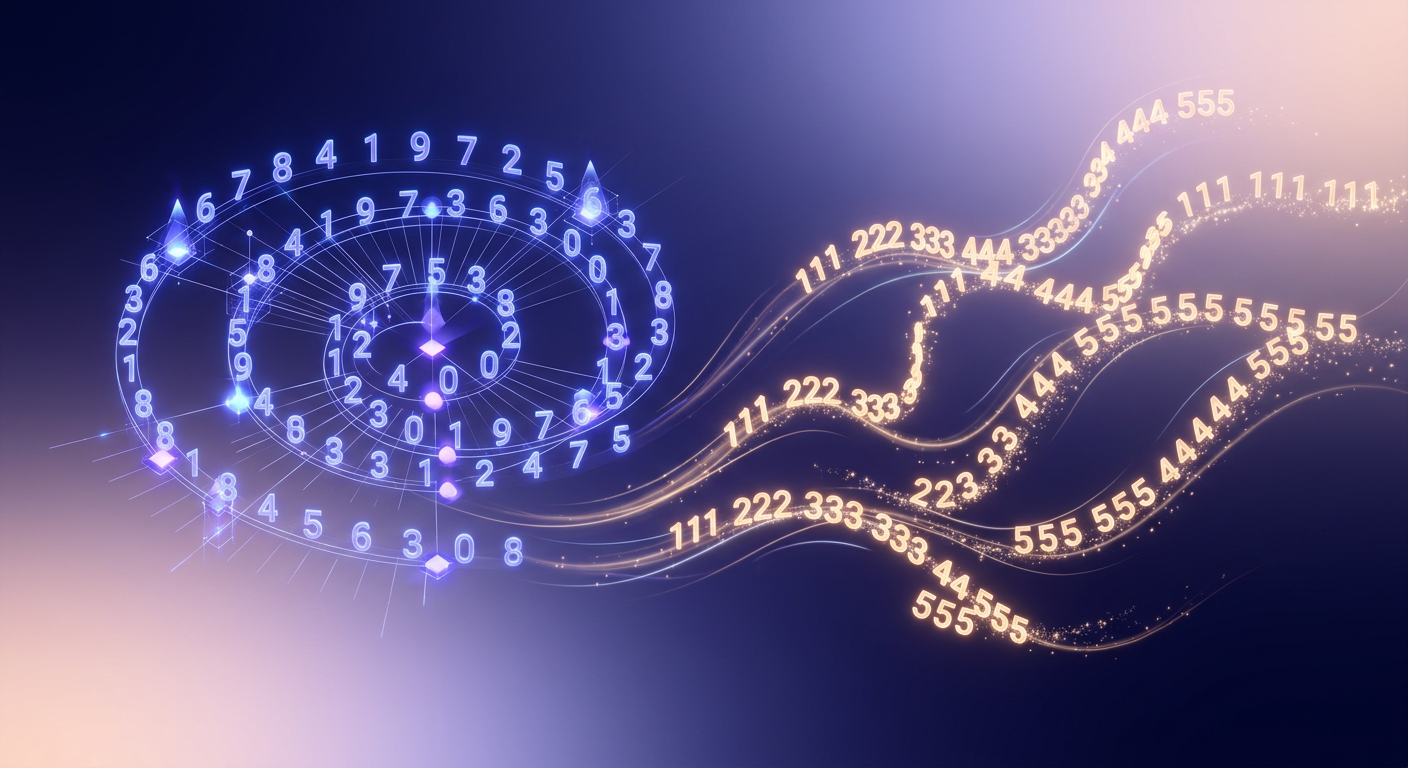
Here's the cleanest way I've found to hold the distinction: numerology is a map of your territory. Angel numbers are weather reports.
Your map doesn't change based on today's weather. But knowing both the map and the current conditions is genuinely more useful than knowing only one. The problem is when people mistake a weather report for a map, or vice versa.
| Strategy | Best For | Pros | Cons | ROI |
|---|---|---|---|---|
| Numerology | Self-knowledge, long-term identity work, understanding life themes | Stable, calculated, internally consistent; based on fixed data | Requires accurate birth info; can feel deterministic; learning curve for full charts | High for introspective work; foundational for any serious number practice |
| Angel Numbers | Real-time pattern awareness, moment-to-moment guidance, intuitive check-ins | Accessible, no calculation required; works anywhere; responsive to current life | Highly subjective; meaning is interpretive; no standardization across sources | High for intuitive types; lower if you need logical consistency |
| Both Systems Integrated | Experienced practitioners who understand the structural difference | Richer picture; identity context + situational signals | Requires clear mental separation of frameworks; risk of confirmation bias | Very high when used with structural awareness; low when used carelessly |
| Neither (Pure Intuition) | People who find structure limiting | Maximum personal freedom | No external framework to check against; fully self-referential | Varies widely by individual |
Which System Should You Use — and When?
If You Want Self-Knowledge: The Case for Numerology
If your goal is to understand yourself — your patterns, your tendencies, your recurring themes across different life phases — numerology is the more appropriate tool. It's designed exactly for that. Your Life Path Number, Expression Number, and Soul Urge Number aren't telling you what's happening right now. They're describing the terrain you're working with across your entire life.
I think numerology is particularly useful when you're at a decision point and you want to check your choices against your actual nature rather than your current mood. It provides a stable reference point that doesn't fluctuate with circumstances.
To build your full numerology profile, you need your complete birth date and your birth name as it appears on your birth certificate. That's the raw data the system works from. The resulting profile gives you a multi-layered picture that goes well beyond a single Life Path Number.
And if you're interested in how numerology compares to other structured frameworks for self-knowledge, tarot vs. astrology vs. numerology does a solid job of laying out what each system is actually built to do.
If You're Tracking Patterns in Daily Life: The Case for Angel Numbers
Angel numbers are better suited for a different kind of practice — one that's more observational, more moment-specific, and more responsive to what's currently happening in your life. If you're going through a major transition and you keep noticing certain number sequences, the angel number framework gives you a vocabulary for exploring what those patterns might mean to you.
But here's the thing: the angel number system works best when you treat it as a prompt for reflection rather than a definitive message. "I keep seeing 222 — what does the idea of balance and partnership mean for where I am right now?" is a more useful question than "222 means I should wait and trust the process." One invites introspection; the other outsources your decision-making.
Synchronicity, as Jung understood it, is a tool for expanding awareness — not a substitute for judgment. The angel number framework is most valuable when it's used in that spirit.
The Risk of Mixing Both Without Understanding the Difference
This is where things get genuinely messy. And I see it happen constantly in spiritual communities.
Someone calculates their Life Path Number 7 and learns that 7 is associated with introspection, analysis, and spiritual seeking. Good so far. Then they start seeing 777 everywhere and look up the angel number meaning, which says 777 is a sign of divine alignment and spiritual awakening. They merge these two pieces of information and conclude that they are a spiritually awakened 7 — their identity number and their current pattern signal reinforcing each other in a loop.
The problem is confirmation bias. When you're using two different systems without clear rules for how they interact, you naturally select the interpretations that confirm what you already believe or want to believe. Every number becomes evidence for the same conclusion. The frameworks stop functioning as checks on each other and start functioning as amplifiers of existing assumptions.
This is also why understanding the foundational symbolism of each digit — the layer that both systems actually share — matters so much. The spiritual meaning of numbers 0–9 covers that shared symbolic foundation, including the often-overlooked role of zero in modern number interpretation.
The fix isn't to abandon one system. It's to be explicit with yourself about which system you're consulting at any given moment and what question that system is designed to answer. Numerology answers: "What is my nature?" Angel numbers answer: "What pattern am I noticing right now?" These are different questions. Keeping them separate keeps both systems useful.
And look, there's also a practical issue: different sources give different angel number meanings. Doreen Virtue's interpretations don't always match what you'll find on a random spiritual blog or in a different author's book. Numerology has more standardization — not perfect standardization, but more. When you're mixing two systems that have different levels of internal consistency, the resulting interpretation is only as solid as its weakest link.
Two Legitimate Frameworks That Serve Different Needs
Both numerology and angel numbers are legitimate frameworks for engaging with number symbolism. Neither is more "real" than the other — they're just doing different things.
Numerology is older, more mathematically structured, and designed to describe who you are at a foundational level. It requires calculation, accurate birth data, and a willingness to sit with what the numbers reveal even when it's not what you expected. It's a long game.
Angel numbers are newer, more intuitive, and designed to help you notice and interpret patterns in real time. They require attentiveness and a willingness to treat coincidence as potentially meaningful. They're a moment-to-moment practice.
The version of these systems that produces actual insight is the version where you know exactly which one you're using and why. Start there — figure out what question you're actually trying to answer — and then choose the framework that's built to answer it.
If self-knowledge and long-term pattern recognition is the goal, build your full numerology profile and start with your core numbers. If you're curious about how numerology fits alongside other structured systems, numerology vs. astrology is worth exploring next. And if you want to understand the complete symbolic framework that both systems ultimately draw from, start with the spiritual meaning of numbers 1–9 — it's the foundation that makes everything else make sense.