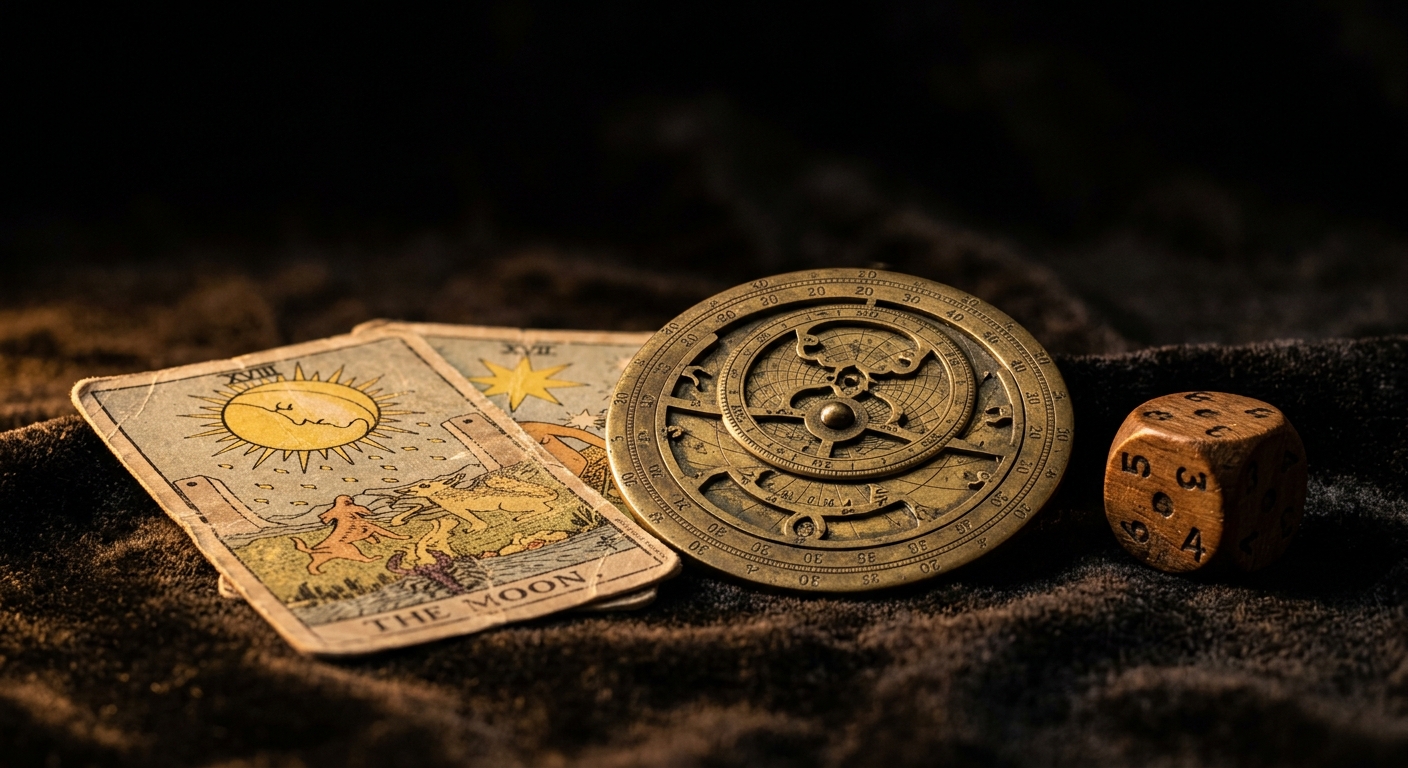
Most people pick a system based on what sounds most interesting — and then spend years wondering why it doesn't quite capture them. That's the wrong starting point. The real question isn't which of these three systems is 'best.' It's what each one is actually doing when it claims to know you.
Tarot, Western Astrology, and Pythagorean Numerology each operate on a fundamentally different assumption about where self-knowledge comes from. One uses fixed math. One reads the sky. One draws on symbolic randomness. And understanding that difference — really understanding it — is worth more than any ranking article could give you.
So let's get into it properly.
Three Systems, Three Completely Different Assumptions About How Self-Knowledge Works
Here's the thing most comparison articles skip entirely: these three systems don't just use different tools. They have different epistemologies — different theories about how truth about a person can be accessed at all.
Numerology assumes your birth data encodes fixed, objective patterns. Astrology assumes that celestial positions at a specific moment create a symbolic map of potential. Tarot assumes that a seemingly random draw can surface what the conscious mind is obscuring. These aren't minor methodological differences. They're completely different answers to the question 'how do we know anything about a person?'
And that matters enormously when you're choosing which system to actually use — or trust.
What Each System Uses as Its Raw Data
Numerology: Fixed Numbers Derived from Birth Data
Pythagorean Numerology works from two inputs: your full birth name and your date of birth. That's it. The system converts letters to numbers (A=1, B=2, and so on), reduces compound numbers to single digits, and derives a set of core numbers — most importantly, the Life Path Number.
The Life Path Number is calculated by reducing your full birth date to a single digit (or one of the Master Numbers 11, 22, or 33). If you were born on March 15, 1990, you'd add 3 + 1 + 5 + 1 + 9 + 9 + 0 = 28, then 2 + 8 = 10, then 1 + 0 = 1. Life Path 1.
What makes this system distinctive is its determinism. Two people with the same birth date get the same Life Path Number. The data doesn't change. There's no interpretation of degrees or house cusps. You either reduce correctly or you don't. (This is also, as we'll see, both its greatest strength and its most significant limitation.)
Astrology: Planetary Positions at a Specific Moment
Western Astrology uses your precise birth time, date, and location to calculate a natal chart — a 360-degree snapshot of where every planet sat in relation to Earth at the moment you were born. The Sun sign most people know is just one of dozens of variables. Your Moon sign, rising sign, Mercury placement, house positions, and the geometric angles (aspects) between planets all contribute to the full picture.
A serious natal chart reading can run 20-30 pages. The data is astronomically precise — literally. And unlike numerology, two people born on the same day but in different cities, or even at different times of day, will have meaningfully different charts.
Astrology also has a robust forecasting arm: transits, progressions, and solar returns track how current planetary positions interact with your natal chart over time. This is where astrology genuinely outperforms the other two systems.
Tarot: Symbolic Archetypes Accessed Through Randomness
Tarot is the odd one out here, and I think it's worth being honest about why. A standard Tarot deck has 78 cards — 22 Major Arcana (The Fool, The Tower, The World, and so on) and 56 Minor Arcana. The reader shuffles, draws cards in a specific layout, and interprets the symbolic meaning of each card in its position.
The 'data source' is, by any objective measure, random. Carl Jung's concept of synchronicity — the idea that meaningful coincidences reflect deeper psychic patterns — is the most intellectually serious framework for why Tarot might work. The draw isn't random in meaning, the argument goes, because the unconscious mind influences the selection. But this is philosophical territory, not empirical ground.
What Tarot genuinely excels at is surfacing ambivalence, complexity, and contextual nuance that fixed systems can't touch. And for many people, that's exactly what they need.
Personality Insight: Head-to-Head Comparison
Depth vs. Consistency vs. Contextual Nuance
This is where the real differences emerge in practice. Numerology gives you a consistent, repeatable personality framework. Your Life Path Number description reads the same on Monday as it does on Friday. That consistency is actually useful — it's hard to gaslight yourself with it.
Astrology gives you extraordinary depth. A full natal chart can describe personality with a granularity that a single Life Path Number simply can't match. But that depth comes with a cost: interpretation. Two competent astrologers reading the same chart can reach meaningfully different conclusions. The system's richness is also its vulnerability to projection.
Tarot gives you contextual nuance — not your personality in general, but what's active or relevant right now. That's a genuinely different kind of insight. But it's almost entirely dependent on the quality of the reader (or your own intuitive literacy if you're reading for yourself).
For a fuller picture of how numerology and astrology specifically stack up on personality depth, the piece on how numerology compares to astrology as a self-knowledge system goes deeper into that specific comparison.
Comparing Strategies: All Three Systems Across Five Criteria
| Criterion | Pythagorean Numerology | Western Astrology | Tarot |
|---|---|---|---|
| Data Source | Birth date + name (fixed math) | Natal chart (planetary positions) | 78-card symbolic deck (randomness/synchronicity) |
| Best For | Consistent self-reference, life themes | Deep personality mapping, timing | Present-moment clarity, exploring ambivalence |
| Pros | Objective, repeatable, easy to learn | Extraordinarily detailed, robust forecasting | Flexible, nuanced, context-sensitive |
| Cons | Can feel reductive, limited by name changes | Complex, requires professional for full depth | Dependent on reader skill, not repeatable |
| ROI (Time to Value) | High — usable in minutes | Medium — months to learn basics | Medium — years to read fluently |
| Failure Mode | Over-simplification | Interpretation bias | Confirmation bias |
| Psychological Framing | Pattern recognition | Symbolic psychology | Jungian archetypes / projection |
Timing and Forecasting: Which System Is Most Useful for 'What's Coming'
Personal Year Numbers vs. Transits vs. Card Spreads
If you want to know what a given year or period might bring, all three systems offer something — but they're not equally equipped.
Numerology's forecasting tool is the Personal Year Number, calculated by adding your birth month and day to the current year. Each number 1 through 9 carries a thematic quality: 1 years are for initiating, 4 years are for building, 9 years are for releasing. It's a nine-year cycle that repeats throughout your life. It's simple, but it's surprisingly useful as a macro-level orientation device.
Astrology's transit system is far more granular. Saturn returns (around age 29-30 and 58-60), Jupiter transits, and progressions can pinpoint specific windows of pressure, opportunity, or transition with remarkable specificity. This is genuinely where astrology shines brightest — the forecasting architecture is sophisticated in ways the other two systems can't match.
Tarot doesn't forecast in the same sense. A card spread can illuminate what's currently in motion and what dynamics are likely to play out if current patterns continue. But it's fundamentally a present-tense tool. Using it to predict specific future events is where most Tarot readings go wrong.
So for timing: Astrology wins. Numerology offers a useful simplified alternative. Tarot is better used for understanding the present than predicting the future.
Ease of Learning and Self-Application
Let's be practical here, because this matters enormously for whether a system actually helps you.
Numerology has the lowest barrier to entry of the three. You can calculate your Life Path Number in two minutes and have a usable framework within an hour of reading. The core concepts — single-digit energies 1 through 9, the Master Numbers, the Personal Year cycle — are learnable without any special training. That's a genuine advantage. (And yes, some of the deeper layers like Expression Numbers, Soul Urge Numbers, and karmic patterns add complexity — but the entry point is remarkably accessible.)
Astrology has a steep learning curve. Understanding the 12 signs is the easy part. Learning the 10 planets, 12 houses, major aspects, and how they interact takes most people 1-3 years of serious study. Reading your own chart fluently is a real skill. Most people benefit from working with a professional astrologer rather than going fully DIY.
Tarot sits somewhere in between, but with a twist: the learning isn't primarily intellectual. You can memorize card meanings in a few months. But developing genuine intuitive fluency — the ability to read cards in relation to each other and to the querent's actual situation — takes years. It's also the system most vulnerable to self-deception when used alone, because there's no objective check on your interpretation.
For self-application without professional help, numerology is the clear winner. That's one reason I'd recommend you start with your Life Path Number as the most objective entry point if you're new to any of this.
Spiritual vs. Psychological Framing: How Each System Positions Itself
This is subtler than it sounds, and it affects how comfortable different people will be with each system.
Numerology can be framed either spiritually (numbers carry divine significance, the universe communicates through numerical patterns) or psychologically (numbers provide a consistent symbolic language for describing personality archetypes). Both framings work with the same calculations. The psychological framing tends to be more accessible to skeptics.
Astrology is similar. Traditional astrology is explicitly cosmological — the planets influence earthly events. Psychological astrology (popularized in the 20th century) reframes the natal chart as a map of psychological tendencies rather than fixed fate. Most contemporary practitioners lean psychological.
Tarot's relationship with Jung is the most explicit of the three. The Major Arcana map closely onto Jungian archetypes — The Shadow, The Anima, The Self. Many modern Tarot practitioners explicitly use the cards as a projective tool, similar in function to a Rorschach test. The 'randomness' is understood as a way to bypass the ego's defenses and surface what the unconscious already knows.
All three systems, in other words, can be practiced without metaphysical commitment — though each also supports a more spiritually inflected approach if that's where you are.
Where Each System Genuinely Fails
Numerology's Blind Spots
Numerology's biggest weakness is its flatness. A Life Path 4 description tells you something real about the 4 energy — but it can't tell you whether that 4 expresses as disciplined and reliable or rigid and controlling. Context, culture, trauma history, and individual variation all shape how a number actually manifests. And the system's reliance on birth names creates a real problem for people who changed their names significantly, were adopted, or don't use their legal name.
There's also the reductiveness of single-digit answers to complex human beings. A full numerology chart (Expression Number, Soul Urge, Maturity Number, and more) adds nuance — but the system still works within a 1-9 framework that many people will find too constrained.
Astrology's Blind Spots
Astrology's failure mode is interpretation bias. The system is complex enough that a skilled practitioner can find almost anything in a chart if they're looking for it. This isn't a criticism unique to astrology — it's a feature of any rich symbolic system. But it means that the quality of an astrological reading is almost entirely dependent on the quality and intellectual honesty of the reader.
Astrology also has a birth-time problem. Even a few minutes of difference can shift your Ascendant or place planets in different houses. Many people don't know their exact birth time. And the system's complexity means most people can't effectively self-apply it without years of study.
Tarot's Blind Spots
Tarot's central vulnerability is confirmation bias. When you draw cards and interpret them yourself, you're working with a system that can mean almost anything — and the human mind is extraordinarily good at finding the meaning it was already looking for. This isn't Tarot's fault, exactly. It's the predictable consequence of any highly interpretive system used without external checks.
The repeatability problem is also real. Draw cards tomorrow on the same question and you'll get a different spread. That's by design — but it makes it nearly impossible to verify whether a reading was accurate or just resonant.
Decision Guide: Which System (or Combination) Fits Your Actual Goals
Rather than a ranking, here's a practical guide based on what you're actually trying to do:
If you want a stable, consistent framework for understanding your core personality and life themes: Start with numerology. Calculate your Life Path Number and Personal Year Number. You'll have a usable self-reference system within an afternoon. For the next layer down, exploring what a full numerology chart actually shows will show you how much more is available beyond the Life Path alone.
If you want deep personality insight and are willing to invest time: Astrology. Get your natal chart done by a competent professional, or invest 1-2 years in serious self-study. The payoff is genuine — a well-interpreted natal chart is the richest personality portrait any of these three systems can produce. For a direct comparison of what each system contributes to that picture, check out the numerology vs. astrology accuracy comparison.
If you want help with present-moment decisions and exploring ambivalence: Tarot. It's genuinely useful for that. Just be honest with yourself about the confirmation bias risk, and consider working with an experienced reader rather than going solo until you've built real interpretive skill.
If you want forecasting: Astrology for depth and specificity; numerology (Personal Year Numbers) for a quick, reliable macro-level view. Tarot for understanding what's currently active, not for predicting what happens next.
If you're curious about combining systems: Many practitioners use all three in complementary ways — numerology for stable self-reference, astrology for timing and depth, Tarot for present-moment reflection. The combined numerology and astrology approach is worth exploring once you have a foundation in at least one system. And if you want to see how Vedic astrology fits into the picture, the Western vs. Vedic astrology vs. numerology comparison covers that ground well.
But honestly? Most people benefit from going deep on one system before adding others. Breadth without depth tends to produce a lot of interesting facts and not much actual self-knowledge.
Why Life Path Numbers Remain the Most Accessible Entry Point
After 12 years working with communications, brand strategy, and the question of how people understand themselves well enough to present themselves clearly — I keep coming back to the same observation: most people are dramatically underserved by vague, high-interpretability systems when they're first building self-awareness.
Tarot requires interpretive skill you haven't built yet. Astrology requires either years of study or a good professional. But numerology gives you something concrete, repeatable, and objective enough to be a genuine anchor — not the whole picture, but a real starting point.
The Life Path Number, in particular, has a clarity that makes it hard to dismiss. It's calculated the same way every time. The meanings are specific enough to be testable against your actual experience. And it scales — once you have your Life Path as a foundation, adding layers like karmic debt numbers or the shadow dimensions of your number builds genuine depth rather than just adding complexity.
So if you haven't yet, start with your Life Path Number as the most objective entry point and see what you actually think. Not because it's the only system worth using — it clearly isn't — but because it gives you something solid to stand on while you figure out what you're actually looking for.
All three systems have something real to offer. The mistake is expecting any one of them to do what the others do. Know what each system is built for, and you'll get far more out of all of them.