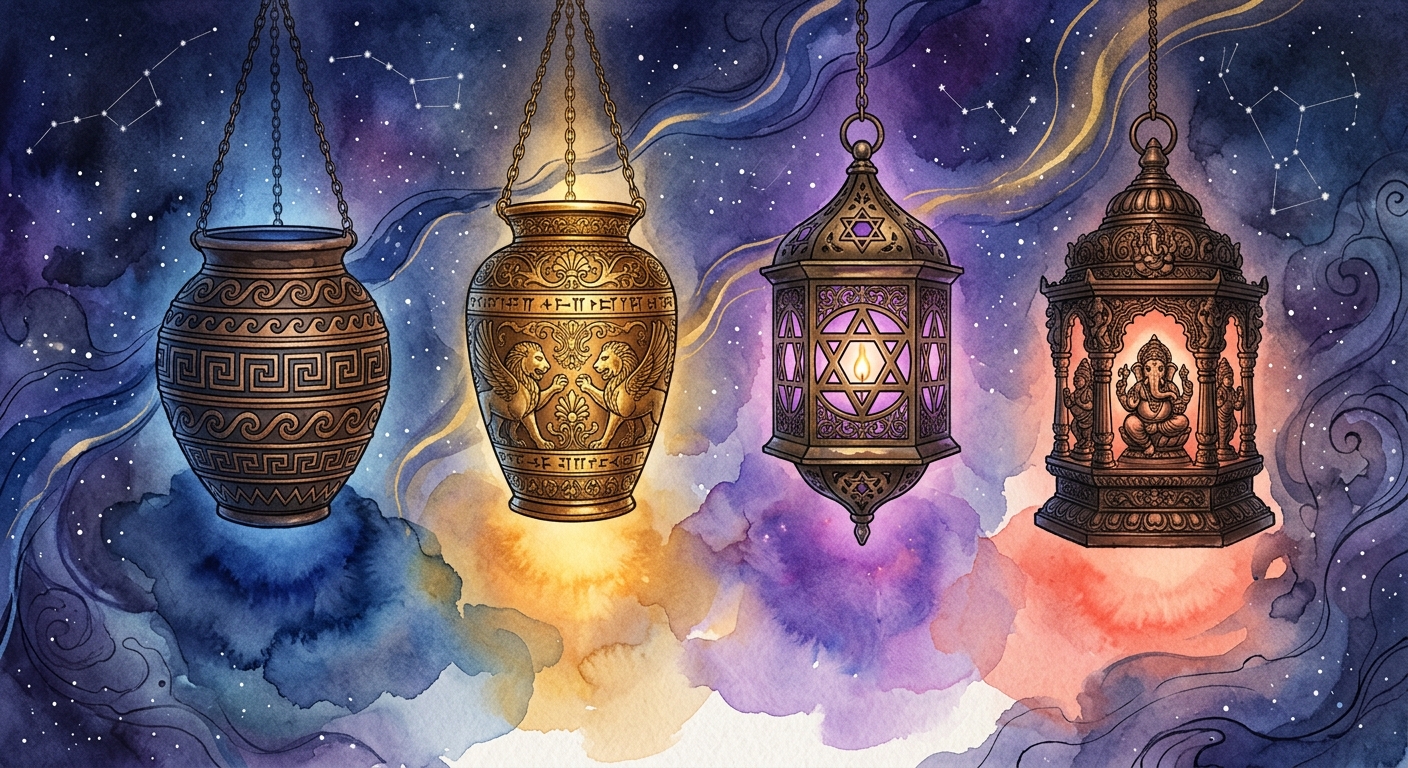
Sometime around your third search for "what does my Life Path Number mean," you probably noticed something strange. One website told you your number is a 7. Another calculated a 5. A third gave you a 3. And all three claimed to be doing numerology.
This isn't a bug. It's actually a feature — though a confusing one. There are four major numerology systems in active use today, and they operate on genuinely different philosophical foundations. They don't just use different names for the same ideas. They make different assumptions about what numbers represent, how letters connect to numbers, and what the resulting calculations actually tell you about a person.
So the question isn't "which calculator made a math error." The question is which system you're using — and whether that's the right choice for what you're trying to understand.
This matters even more when you consider how numerology's internal diversity compares to astrology's competing systems. Astrology has its own internal debates (tropical vs. sidereal, Placidus vs. whole sign houses), but numerology's four major branches diverge at an even more fundamental level: the basic letter-to-number assignments themselves.
Let's break down each system properly — not just what it is, but why it works the way it does.
Why There Isn't Just One Numerology (And Why That Matters)
Numerology developed independently across multiple ancient cultures, each with its own cosmology, alphabet, and philosophy of what numbers represent. The Greek tradition produced one system. The Babylonian-Chaldean tradition produced another. Jewish mysticism produced a third. And the Vedic tradition of the Indian subcontinent produced a fourth.
Here's the thing: these weren't parallel discoveries of the same underlying truth. They were genuinely different answers to genuinely different questions. Some systems ask, "What energy does a name vibrate at?" Others ask, "What planetary force governs this person's life?" Still others ask, "What is the soul's resonance in this lifetime?"
Because the questions differ, the methodologies differ — and so do the outputs.
This is why choosing a numerology system is a meaningful decision, not an arbitrary one. When you calculate your Life Path Number using the Pythagorean method, you're not just picking a calculator. You're choosing a philosophical framework with specific assumptions baked into it.
Pythagorean Numerology: The Western Standard
How It Works and What It Calculates
Pythagorean numerology assigns letters to numbers sequentially: A=1, B=2, C=3, and so on through I=9, then cycling back to J=1, K=2, and continuing through the alphabet. It's clean, logical, and easy to teach.
The system calculates several core numbers from your full birth name and birth date: the Life Path Number (from your birth date), the Expression Number (from your full name), the Soul Urge Number (from vowels only), and the Personality Number (from consonants only).
Why Life Path Numbers Are Almost Always Pythagorean
The Life Path Number — the most widely discussed number in popular numerology — is calculated purely from your birth date, not your name. This means the Pythagorean vs. Chaldean debate doesn't actually affect it. Both systems use the same birth date reduction method for this particular calculation.
But here's where it gets interesting: the name-based numbers diverge dramatically between systems. And because Pythagorean numerology is the dominant Western framework, most resources you'll encounter online are using it by default — often without saying so explicitly.
Its Strengths and Known Limitations
The Pythagorean system's biggest strength is standardization. Because it's the most widely used system in the English-speaking world, you can compare readings across sources, find abundant learning materials, and discuss results with a shared reference point.
Its limitation is philosophical rather than mathematical. The sequential letter assignment (A=1, B=2, C=3) is essentially arbitrary from a mystical standpoint — it reflects the order of the modern English alphabet, not any ancient vibrational theory. Practitioners of other systems argue this makes Pythagorean name calculations less meaningful than they appear. (It's a fair critique, honestly.)
That said, for concepts like master numbers 11, 22, and 33 and their deeper significance, Pythagorean numerology provides the most developed body of interpretation.
Chaldean Numerology: The Older, More Complex System
How Letter-to-Number Assignments Differ from Pythagorean
Chaldean numerology originated with the Chaldean civilization of ancient Babylon — one of the earliest cultures to systematically study the relationship between numbers, celestial bodies, and human experience. Its letter-to-number assignments are not sequential. Instead, they're based on the vibrational quality the Chaldeans believed each number carried.
The most significant difference: the number 9 is considered sacred in Chaldean numerology and is never assigned to a letter. The assignments go from 1 to 8, with 9 reserved for divine or cosmic energy. This single philosophical choice changes virtually every name calculation.
So the same name — say, "Sarah" — will produce a different Expression Number in Chaldean than in Pythagorean. Not because someone made an error, but because the two systems are answering slightly different questions with different tools.
What Chaldean Numerology Claims to Measure That Pythagorean Doesn't
Chaldean practitioners argue their system captures the outer name (what you're called in the world) and the inner name (your full birth name) separately, and that the vibrational assignments reflect something closer to the actual sound-energy of letters rather than their alphabetical order.
The Chaldean system also places more emphasis on compound numbers — two-digit results before they're reduced to a single digit. A compound number like 14 isn't just "a 5" in Chaldean; it carries its own specific meaning layered beneath the final digit. This makes Chaldean readings more granular, and arguably more complex to interpret.
For readers interested in layered readings, the concept of karmic debt numbers 13, 14, 16, and 19 actually has roots in this kind of compound-number thinking — where the two-digit form carries distinct weight beyond the reduced result.
Kabbalah Numerology: The Name-Focused Approach
Its Origins in Jewish Mysticism and How It's Been Adapted
Kabbalah numerology draws from the Jewish mystical tradition of Kabbalah, which sees the Hebrew alphabet as containing encoded divine information. In its original form, it worked with Hebrew letters and their established numerical values (Aleph=1, Bet=2, and so on through a 22-letter alphabet).
The modern Western adaptation of Kabbalah numerology applies this framework to the English alphabet — a translation that purists in both numerology and Kabbalah scholarship find problematic. But in popular practice, it's been adapted to work with any name by assigning values based on a modified Hebrew-to-English mapping.
Why It Produces Different Results from the Other Systems
Here's what makes Kabbalah numerology genuinely distinct from everything else on this list: it focuses almost exclusively on the name. Birth dates play a minimal role or none at all, depending on the practitioner.
This is a profound philosophical difference. Where Pythagorean and Chaldean numerology treat your birth date as carrying essential soul-level information, Kabbalah numerology centers on the name as the primary vehicle of identity and destiny. The name, in Kabbalistic thought, isn't just a label — it's a spiritual blueprint.
The result is that Kabbalah numerology produces readings that can feel quite different in character. They tend to focus on the soul's purpose and spiritual lessons rather than personality traits and life circumstances. And because the calculation method differs, the numbers themselves often differ too.
If you're exploring how different divination frameworks approach identity, tarot vs. astrology vs. numerology offers a useful broader comparison — Kabbalah numerology actually has interesting philosophical overlaps with tarot's archetypal approach.
Tamil (Indian) Numerology: The Vedic Counterpart
How It Connects to Vedic Astrology
Tamil numerology — sometimes called Indian numerology or Vedic numerology — emerged from the same tradition that produced Vedic astrology, Ayurveda, and the broader system of Indian cosmological thought. It's been practiced in South Asia for thousands of years and remains deeply embedded in cultural life there, particularly in Tamil Nadu.
The key connection to Vedic astrology is planetary rulership. In Tamil numerology, each number from 1 to 9 is governed by a specific planet: 1 by the Sun, 2 by the Moon, 3 by Jupiter, 4 by Rahu (the north lunar node), 5 by Mercury, 6 by Venus, 7 by Ketu (the south lunar node), 8 by Saturn, and 9 by Mars.
This isn't just a symbolic association. It means that a Tamil numerology reading carries the full interpretive weight of Vedic planetary theory — including concepts like planetary periods (dashas), favorable and unfavorable planetary influences, and remedial measures (specific practices to balance difficult planetary energies).
Key Differences in Number Interpretation
In Tamil numerology, three core numbers are calculated: the Psychic Number (from the day of birth), the Destiny Number (from the full birth date), and the Name Number (from the name). But their meanings are filtered through planetary associations in a way that has no direct parallel in Western systems.
For example, the number 8 in Pythagorean numerology is associated with ambition, power, and material success. In Tamil numerology, 8 is ruled by Saturn — which brings themes of discipline, karma, delay, and eventual reward through persistence. The interpretation isn't opposite, but it's considerably more nuanced and carries different prescriptive implications.
This planetary layer is what makes Tamil numerology feel cosmologically rich in a way the Western systems generally don't. It also means that combining it with numerology and astrology together is more natural in the Vedic framework than in the Pythagorean one — the two systems were never really separate to begin with.
Side-by-Side Comparison: What Each System Does Best
| System | Origin | Key Focus | Birth Date Used? | Number 9 Assigned to Letters? | Best For |
|---|---|---|---|---|---|
| Pythagorean | Ancient Greece | Personality + Life Path | Yes | Yes | Beginners, standardized readings |
| Chaldean | Ancient Babylon | Name vibration + compound meanings | Yes | No (sacred) | Deeper name analysis |
| Kabbalah | Jewish mysticism | Soul purpose through name | Minimal | Modified assignments | Spiritual/soul-level focus |
| Tamil/Vedic | Indian subcontinent | Planetary life forces | Yes | Yes | Vedic astrology integration |
How to Choose the Right System for Your Goals
So which system should you actually use? I think the honest answer depends on what you're trying to get out of numerology.
If you want standardized, widely-supported readings: Pythagorean is your best starting point. The sheer volume of interpretive material available — books, articles, community discussions — means you can go deep without hitting a wall of conflicting resources. It's also the system used by the vast majority of Western numerology practitioners.
If you want more nuanced name analysis: Chaldean is worth exploring seriously. Its compound-number emphasis and non-sequential assignments give it a layer of specificity that Pythagorean name readings lack. Many experienced numerologists use Pythagorean for birth-date calculations and Chaldean for name analysis.
If your primary interest is spiritual identity: Kabbalah numerology's name-focused approach may resonate more deeply, particularly if you're drawn to mystical traditions or already have some familiarity with Kabbalistic thought.
If you're already engaged with Vedic astrology or Indian philosophy: Tamil numerology will feel like a natural extension rather than a separate discipline. Its planetary framework integrates seamlessly with what you may already know.
And look, there's nothing wrong with exploring more than one system. Many serious practitioners are fluent in at least two. The key is being intentional about which system you're using for which purpose — and not mixing methodologies in ways that produce meaningless hybrid results.
Why Most Life Path Number Resources Default to Pythagorean — and Whether That's a Problem
Let's be direct about something: the dominance of Pythagorean numerology in English-language resources isn't because it's been scientifically validated as more accurate. It's because it got there first in the Western publishing tradition, it's easier to teach, and standardization tends to compound over time.
Is that a problem? Not necessarily. But it's worth being aware of.
The practical consequence is that when you read about Life Path Numbers — including the rich body of interpretation around karmic debt numbers and shadow work — you're almost certainly reading Pythagorean interpretations. That's fine as long as you know it. The issue arises when people assume Pythagorean is numerology, full stop, and dismiss the other systems without understanding what they actually offer.
Chaldean practitioners would argue their system is older and more vibrationally grounded. Tamil numerologists would point to thousands of years of continuous practice and a cosmological framework that integrates planetary cycles in ways Pythagorean numerology simply doesn't attempt. Kabbalah scholars would note that their system's philosophical depth predates the modern Western adaptation by centuries.
All of these points have merit. None of them definitively "win" the debate.
What I'd suggest: start with Pythagorean because the resources are better and the community is larger. Learn it properly — not just your Life Path Number, but your Expression Number, Soul Urge, and how a full numerology chart works together as a system. Once you have that foundation, explore Chaldean name analysis as a complement. See if the two readings illuminate each other or contradict each other — and pay attention to which feels more resonant with your actual experience.
That resonance test isn't unscientific. It's actually how most experienced practitioners refine their system preference over time.
Your next concrete step: if you haven't already, calculate your Life Path Number using the Pythagorean method to establish your baseline. Then come back to this article and consider how the Chaldean or Tamil framework might add a different layer to what you find. The four systems aren't competitors so much as they are four different lenses — and sometimes the clearest picture comes from knowing what each one sees.