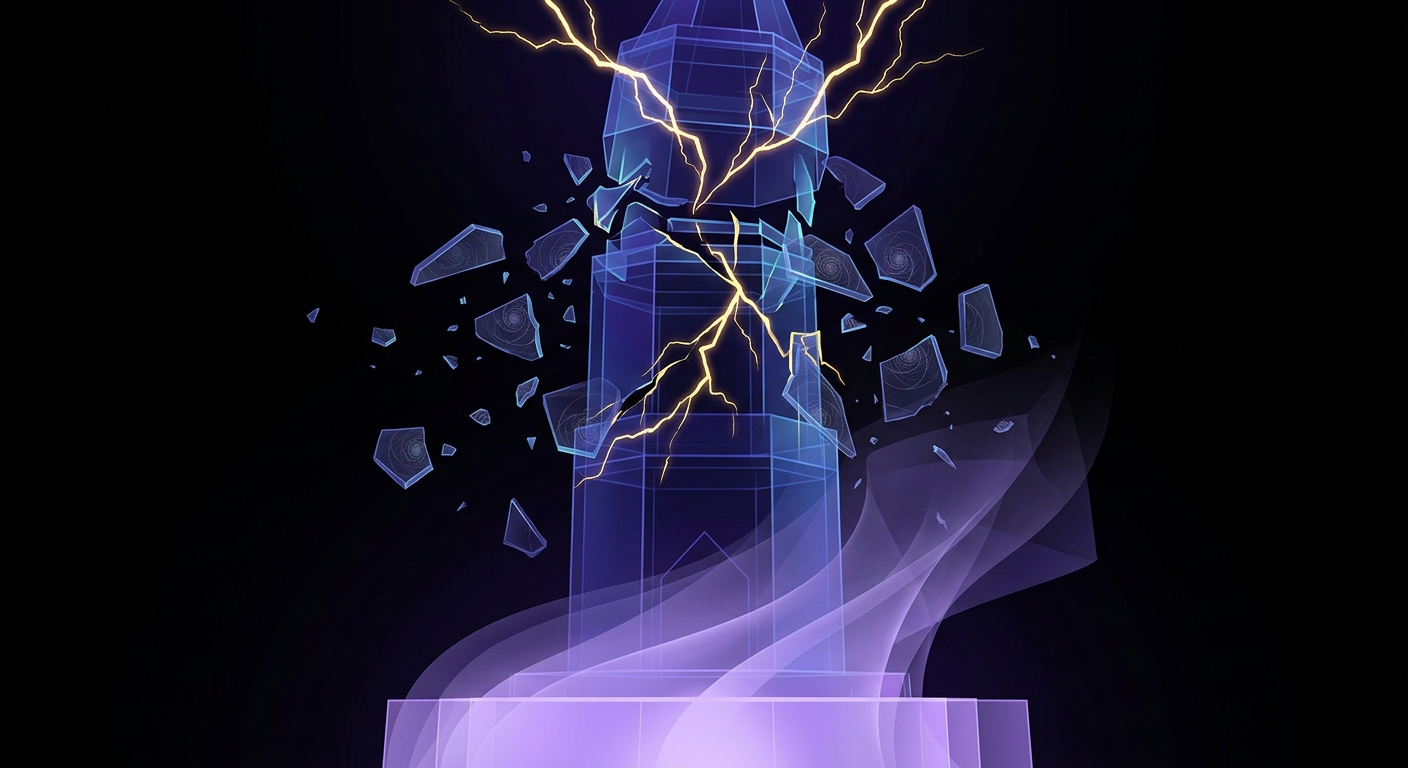
Imagine you've built something you're genuinely proud of. A career, a relationship, a carefully constructed self-image — the version of yourself you present to the world with quiet confidence. Then, without much warning, it comes apart. Not gradually. Not with a chance to course-correct. It collapses in a way that feels almost architectural, like a load-bearing wall gave way.
And then — here's the part that really stings — it happens again. Different circumstances, same essential shape. The relationship ends in a way you didn't see coming. The professional identity you rebuilt gets dismantled again. The spiritual certainty you'd found starts to crack.
If this pattern feels familiar, karmic debt number 16 may be one of the most important numbers in your numerology chart. Not because it's a curse. But because understanding what it's actually doing changes everything about how you respond to it.
Why Karmic Debt 16 Is Considered the Most Intense
Among the four karmic debt numbers and their meanings, the number 16 carries a specific reputation. Numerologists consistently describe it as the most disruptive — not because it brings the most suffering in raw terms, but because of how it operates. Karmic debts 13 and 14 tend to work through accumulation and repetition. Karmic debt 19 works through isolation and self-reliance lessons. But 16 works through collapse.
The mechanism is specific: structures built on ego, pride, or false identity get dismantled. And the dismantling tends to be sudden, public, and thorough. There's rarely a gentle warning. The Tower doesn't sway before it falls.
What makes this particularly challenging is that many people with karmic debt 16 are genuinely talented, intelligent, and capable of building impressive things. The problem isn't incompetence — it's the motivation behind the building. When something gets constructed primarily to protect the ego or to project an image, 16 energy treats it as structurally unsound. And eventually, it comes down.
The Past-Life Story Behind Number 16
Pride, Betrayal, and Misuse of Love
In numerological tradition, karmic debts are understood as unresolved patterns carried forward from previous lifetimes. The soul arrives with a specific lesson it failed to integrate, and this current life becomes the curriculum for working through it.
The past-life narrative associated with 16 centers on a particular kind of betrayal — not the betrayal of others, but of one's own higher values. The soul, in a previous incarnation, is understood to have misused love, trust, or spiritual knowledge. Often this involves placing personal pride above genuine connection, or using spiritual understanding as a source of superiority rather than service.
Some numerological traditions describe it more specifically: a soul who was entrusted with wisdom, love, or power, and who used that trust for personal gain or ego elevation. The debt, then, isn't punishment — it's the soul's own agreement to come back and learn what genuine love and genuine humility actually feel like from the inside, without the armor.
The Tower Card Parallel in Tarot
If you're familiar with tarot, the Tower card (Major Arcana XVI) maps onto karmic debt 16 with almost uncomfortable precision. (The Roman numeral XVI is, of course, 16 — this parallel is not coincidental in esoteric traditions.)
The Tower depicts a tall structure being struck by lightning. People fall from the windows. The crown at the top is blown off. Everything that was built — often with great effort and pride — comes down in an instant.
But here's what most people miss about the Tower: it's not a card about destruction for its own sake. It's a card about false structures. The tower falls because it was built on an unstable foundation. The lightning doesn't create the problem — it reveals one that was already there. After the fall, the ground is clear. Something real can be built in its place.
This is the core reframe for understanding karmic debt 16. The collapses aren't random misfortune. They're structural corrections. The ego built something that couldn't hold, and 16 energy ensures that what can't hold eventually doesn't.
The Signature Patterns of Karmic Debt 16 in Daily Life
Sudden Losses and Unexpected Collapses
People carrying karmic debt 16 often describe a recurring experience: things fall apart in ways that seem disproportionate to any apparent cause. A relationship ends not with a slow fade but with an abrupt revelation. A career gets derailed not by gradual performance issues but by a sudden restructuring or unexpected conflict. A friendship dissolves over something that, in retrospect, was clearly a long-building fault line — but felt sudden in the moment.
So the first signature pattern is suddenness. The collapses tend to be fast, and they tend to be complete. There's rarely a partial dismantling.
The second signature is recurrence. Many people with 16 in their chart report that this pattern repeats across different life domains. It's not that one area of life is unstable — it's that the same essential experience (build, collapse, rebuild) cycles through relationships, career, identity, and sometimes physical circumstances.
Romantic Relationships as the Primary Battleground
If there's one domain where karmic debt 16 tends to concentrate its energy, it's romantic love. This makes a certain sense: nowhere else do we invest more ego, construct more elaborate self-narratives, or become more vulnerable to the gap between who we present ourselves as and who we actually are.
People with karmic debt 16 often experience romantic relationships that feel profound and significant — and then end in ways that feel like the ground dropped out. The pattern frequently involves some element of illusion: either they idealized a partner, or a partner idealized them, or both parties were relating to constructed images rather than actual people.
The lesson here isn't 'avoid love' — it's 'learn to love without the ego architecture.' Genuine intimacy requires showing up as you actually are, not as the version of yourself you've carefully built. Karmic debt 16 keeps dismantling relationships until that lesson lands.
Isolation and the Search for Deeper Meaning
After repeated collapses, many people with karmic debt 16 naturally withdraw. And here's the thing — this withdrawal is often exactly right. Not as avoidance, but as genuine reflection. The 7 energy at the core of 16 (1+6=7) is fundamentally oriented toward inner life, solitude, and the search for meaning beneath surface appearances.
But the isolation can also become a trap. If it's driven by bitterness or a sense of being uniquely persecuted, it reinforces the ego rather than dissolving it. The question karmic debt 16 keeps asking is: can you be alone without making your aloneness a story about yourself?
The 7-Energy Core: Spirituality as the Path Through
This is where the numerology gets genuinely interesting. Karmic debt 16 reduces to 7 (1+6=7), and this isn't just arithmetic — it's the key to understanding what the 16 experience is actually trying to produce.
If you want to understand the deeper qualities of 7 energy, the spiritual meaning of numbers 1–9 offers a useful framework. In brief: 7 is the number of inner knowing, spiritual depth, and the kind of understanding that can only come from genuine solitude and reflection. It's the researcher, the mystic, the person who needs to understand why at the level of first principles.
Karmic debt 16/7 means that the destruction (16) exists specifically to produce the depth (7). You can't force 7 energy. You can't think your way into genuine spiritual understanding or manufacture real inner knowing. But you can be stripped of the things that were substituting for it.
Why Intellectual Arrogance Blocks Progress
Here's the specific trap for people with karmic debt 16: many of them are genuinely intelligent. They're often the person in the room who understands things quickly, who can construct elegant explanations, who mistakes the map for the territory.
Intellectual arrogance — the belief that having thought about something deeply means you understand it fully — is the specific mechanism that triggers the next collapse. Because 7 energy, at its highest expression, knows what it doesn't know. It holds understanding with humility. When someone with 16/7 energy starts treating their spiritual or intellectual framework as a finished product, as something to defend rather than something to deepen, the Tower tends to appear.
I think of it this way: the moment you're certain you've figured out the pattern, you've just built the next thing that needs to come down.
Solitude as a Tool, Not a Punishment
The path through karmic debt 16 runs directly through solitude — but solitude of a particular quality. Not isolation born of hurt or superiority ('nobody understands me anyway'), but the deliberate, curious kind. The kind where you sit with questions rather than reaching for answers.
This is the 7 energy working correctly. People who learn to use their solitude this way — as a genuine practice of inner inquiry rather than a retreat from a world that keeps disappointing them — tend to develop a quality of understanding that's genuinely rare. They've been stripped of the surface-level certainties that most people never question, and what remains is something more real.
Karmic Debt 16 in Different Chart Positions
On the Life Path: A Lifetime of Rebuilding
When karmic debt 16 appears on the Life Path number, it means the collapse-and-rebuild cycle is the central theme of the entire lifetime. To discover your life path number, you reduce your full birthdate to a single digit — but crucially, you need to check the unreduced numbers at each step to identify karmic debts. A Life Path 7 that comes through 16 carries this debt; a Life Path 7 that doesn't pass through 16 doesn't.
For those with 16 on the Life Path, the rebuilding isn't a phase — it's the curriculum. The question isn't 'when will this stop?' but 'what am I supposed to understand about myself each time this happens?' Each collapse, ideally, removes another layer of ego-constructed identity and leaves something more authentic in its place.
You can use a karmic debt number calculator to identify whether your 7 Life Path carries this specific debt, or whether the debt appears elsewhere in your chart.
In the Expression Number: How You Present vs. Who You Are
When karmic debt 16 appears in the Expression Number (calculated from the full birth name), the dynamic is slightly different. The Expression Number describes how you naturally engage with the world — your talents, your communication style, your outer personality.
A 16 in the Expression position often creates a specific tension: the person presents with confidence, competence, and a certain authority — but there's a gap between the presentation and the inner reality. Others may see someone who 'has it together' in ways the person themselves doesn't feel. And the collapses that karmic debt 16 produces tend to be particularly visible, because they happen in the domain of how you're seen by others.
This can feel humiliating in a way that 16 on the Life Path doesn't — because it's public. But the lesson is the same: the gap between presentation and reality is exactly what needs to close.
The Gift Hidden Inside Karmic Debt 16
Look, it would be dishonest to write about karmic debt 16 without acknowledging that it's genuinely hard. The repeated experience of building something and watching it collapse is painful. The isolation that often follows is real. The sense that you're somehow uniquely cursed can be overwhelming.
But here's what I've seen in people who've genuinely integrated this energy: they develop a quality of understanding that's almost impossible to manufacture any other way. Because they've had their certainties stripped away repeatedly, they hold their beliefs more lightly. Because they've experienced the gap between image and reality, they're less susceptible to illusion — in themselves and in others. Because they've rebuilt from nothing more than once, they know what actually matters.
The gift of karmic debt 16 is a particular kind of wisdom: hard-won, ego-free, and real in a way that purely intellectual understanding never quite is. People who've worked through significant 16 experiences often become the person others turn to in genuine crisis — not because they have answers, but because they've learned to sit with uncertainty without flinching.
How to Work With — Not Against — Karmic Debt 16
Working with karmic debt 16 is less about technique and more about orientation. Here's a framework that actually helps:
1. Audit your constructions regularly. What are you building, and why? If the honest answer involves protecting an image or avoiding a fear, that's worth examining before life examines it for you. Voluntary humility is significantly less painful than the involuntary kind.
2. Treat collapses as information, not punishment. When something falls apart, the first question isn't 'why is this happening to me?' — it's 'what was this built on that couldn't hold?' This isn't about self-blame. It's about getting genuinely curious about the structural question.
3. Develop a real solitude practice. Not distraction, not consumption, not even meditation as a productivity tool. Genuine time with your own thoughts, your own questions, your own uncertainty. This is where 16/7 energy actually processes and integrates.
4. Watch for intellectual arrogance as a warning signal. When you notice yourself feeling certain that you've finally figured something out — especially about yourself or your spiritual understanding — treat that as a prompt for curiosity, not a conclusion.
5. Build relationships on honesty rather than impression. The relationships that survive karmic debt 16 are the ones where you showed up as yourself rather than as a carefully managed version of yourself. This is harder than it sounds, but it's the only construction that 16 energy won't eventually dismantle.
6. Connect the collapses across time. Look at the pattern across your life, not just the most recent event. What's the common thread? What identity or belief structure keeps appearing in different forms? That thread is the actual lesson.
Karmic Debt 16 vs. Karmic Debt 19: Key Differences
These two are sometimes confused, partly because both involve a kind of isolation and partly because both carry significant intensity. But the mechanisms are quite different.
Karmic debt 13 and karmic debt 14 both operate through accumulation — habits, patterns, and resistances that build over time. Karmic debt 19, by contrast, is specifically about misused independence and the refusal to accept help or connection. The 19 lesson is learning that genuine strength includes vulnerability and interdependence.
Karmic debt 16 is different from both. It's not about accumulation, and it's not primarily about independence. It's about ego structure — the gap between constructed identity and authentic self. Where 19 tends to produce isolation through stubbornness and self-sufficiency, 16 produces isolation through the aftermath of collapse. The loneliness of 19 is chosen; the loneliness of 16 is often the clearing that remains after something falls.
And where 19 people often know, on some level, that they're refusing connection, 16 people are frequently genuinely surprised by their collapses. They thought they were building something real. That surprise is part of the lesson.
For anyone trying to determine which karmic debt is most active in their chart, the position matters enormously. The same number carries different weight depending on whether it appears in the Life Path, Expression, Soul Urge, or another position. A full chart reading, rather than a single number focus, gives the clearest picture of how these energies interact.
The deeper truth about karmic debt 16 is this: it's not trying to break you. It's trying to find out what's actually there when the constructed parts are removed. Every collapse is, in that sense, an invitation — not a pleasant one, but a genuine one. The soul that carries this debt came here specifically to discover what it's made of beneath the architecture. And the only way to find that out is to let the architecture come down.
Start by understanding where this energy sits in your own chart. The numbers are specific, and the position changes everything about how the lesson arrives.